Hotel-inspired home fragrance has moved from the lobby to the living room. Why it is catching on, what the research says about air quality, and how a Quebec company is bottling the experience.
Anyone who has walked into a W Hotel or a Four Seasons knows the lobby smells a certain way. That is by design. Luxury hotels have long treated scent as part of the brand, and guests have long wanted to take it home. Spence Levy, president of the scent company Air Esscentials, has said his business grew because guests at Ritz-Carlton and Sonesta properties “would go up to the front desk and ask how they could get it.”
Now they can. Cold-air diffusers, once a commercial product, are sold for condos, bedrooms and even cars. The shift gained speed during the pandemic, when people spending more time at home began investing in what the industry calls scentscaping: using fragrance to change how a space feels.
Why it’s catching on
Part of the appeal is shorthand. “Hotel scent” tells a shopper what to expect: clean, polished, quietly expensive. Part of it is memory. Tara Cruz, senior spa director at the Four Seasons Hotel New York Downtown, has noted rising demand for at-home scent among guests, pointing out that a fragrance can take people back to a particular time and place.
Then there is convenience. Cold-air diffusers use no heat, flame or water, and most can be scheduled from a phone. The interest is spreading beyond the home, too. Trend tracker Spate reported in November 2025 that interest in car diffusers was up 30.8% year over year.
Are they safe?
For most healthy adults using them in moderation, the risk appears limited, but diffusers do change indoor air. A study of 60 homes in Ashford, England, found that a plug-in fragrance diffuser raised concentrations of fragrance-related volatile organic compounds (VOCs), with the largest increases in homes with poor air exchange.
People with asthma, allergies or migraines are more likely to react, as are young children and pets (cats and birds in particular, around essential oils). The usual advice is straightforward: use the lowest effective setting, run the diffuser on a schedule rather than around the clock, and ventilate regularly. Flair’s own troubleshooting guide makes a similar point, noting that an overwhelming scent usually means the intensity is set too high for the space.
The brand: Flair Diffusers
Flair Diffusers was founded in 2009 and is based in Laval, Quebec. It markets itself as proudly Canadian under the tagline “Elevate the air, with Flair.”
Flair organises its lineup pf products by coverage area.
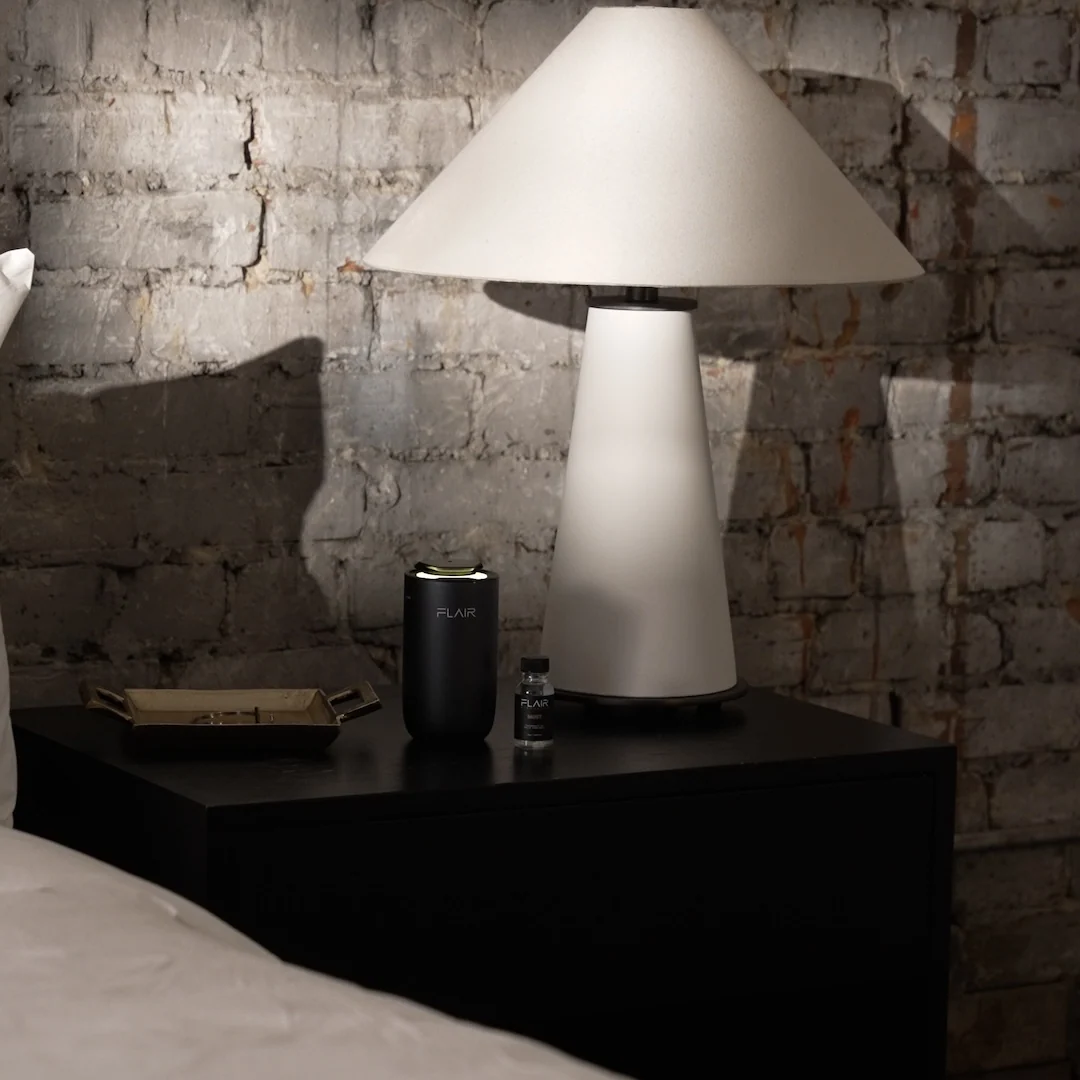
The Nova was the product we tested, and it works for one room only. It’s quality is great. It is a compact aluminum unit about 76 millimetres tall, covers up to 350 square feet, though the company’s FAQ says it performs best under 300. It suits a bathroom or bedroom.
Other options are offered to cover a bigger square feet ; The Neo and the Plug-in each cover up to 750 square feet; the Neo adds Bluetooth control and three intensity levels, making it a fit for a kitchen or primary bedroom. For open-concept living areas, the Wireless Tower covers up to 1,500 square feet and runs roughly 100 hours per charge at medium intensity. At the top of the range, the Maestro M (4,000 square feet) and Maestro L (8,000 square feet, with a one-litre bottle and Wi-Fi control) are designed to connect to an HVAC system and scent an entire house, or a hotel.
The scents
We tried the Chalet Chic, a woody blend of sandalwood and amber, and it is a natural fit for a Canadian winter.
The centrepiece is the Hotel Experience collection, which we haven’t had the pleasure to smell yet. The Déjà Vu, inspired by 1 Hotel, blends leather, sandalwood and vetiver. Emotion, inspired by the W, pairs bergamot, magnolia and koa. Monaco, modelled on Miami’s E11EVEN Hotel, combines white peach, ylang-ylang and sandalwood. Must, inspired by the Four Seasons, features wild fig, wild hyacinth and cedarwood, and is listed among the brand’s bestsellers.
The wider range takes cues from niche perfumery. Eden is inspired by Le Labo’s Santal 33, with cardamom and white musk, and Aura by Baccarat Rouge 540, with saffron and ambergris.
For years, the answer to “what is that scent?” stayed behind the front desk. Today it is as accessible as even, sold by the bottle in Laval and on their website.