Three large-scale audiovisual installations, a solar eclipse rave, and a preview of new work mark the artist’s most ambitious institutional project to date.
Björk’s exhibition at the National Gallery of Iceland opens on 30 May 2026, and it is not a retrospective. It is a forward movement, rooted in grief and animated by curiosity about what comes next. The show brings together three large-scale audiovisual works across a venue in Reykjavík that, for four months, will become one of the more serious sites for contemporary art and sound anywhere in the world.
At its core are two works conceived during the Fossora era: Ancestress and Sorrowful Soil. Both were written in memory of Björk’s mother, and both are presented here in a museum context for the first time, scaled up from their original forms into something closer to theater. Ancestress is set within a remote Icelandic valley and unfolds as a ritualistic meditation on ancestry, grief, and renewal, combining cinematic landscape with choral procession and movement. It is slow, deliberate, and austere in the way that grief actually is, not in the way that sentiment pretends it to be.
Sorrowful Soil operates differently. It is a nine-part choral sound installation built across thirty individual speaker channels, transmitting voices from the Hamrahlíð Choir under the direction of Þorgerður Ingólfsdóttir. The Finnish audio company Genelec, the exhibition’s official audio partner, provides the spatial sound systems that make this possible, their loudspeaker technology designed to allow each voice to occupy its own distinct position in the room. The result, when it works as intended, dissolves the distinction between architecture and acoustics. The gallery itself becomes the instrument.
The third installation is new, drawn from Björk’s forthcoming body of work and presented here as an early glimpse into that creative chapter through sound, film, and immersive technology. Apple joins the exhibition as VR partner. AIAIAI, the Copenhagen-based audio company, provides headphone technology throughout. Visitors to the show will experience sound through AIAIAI’s TMA-2 Move headphones, a detail that matters more than it might seem: the physical act of putting on headphones in a gallery recalibrates attention, makes listening intentional rather than ambient.
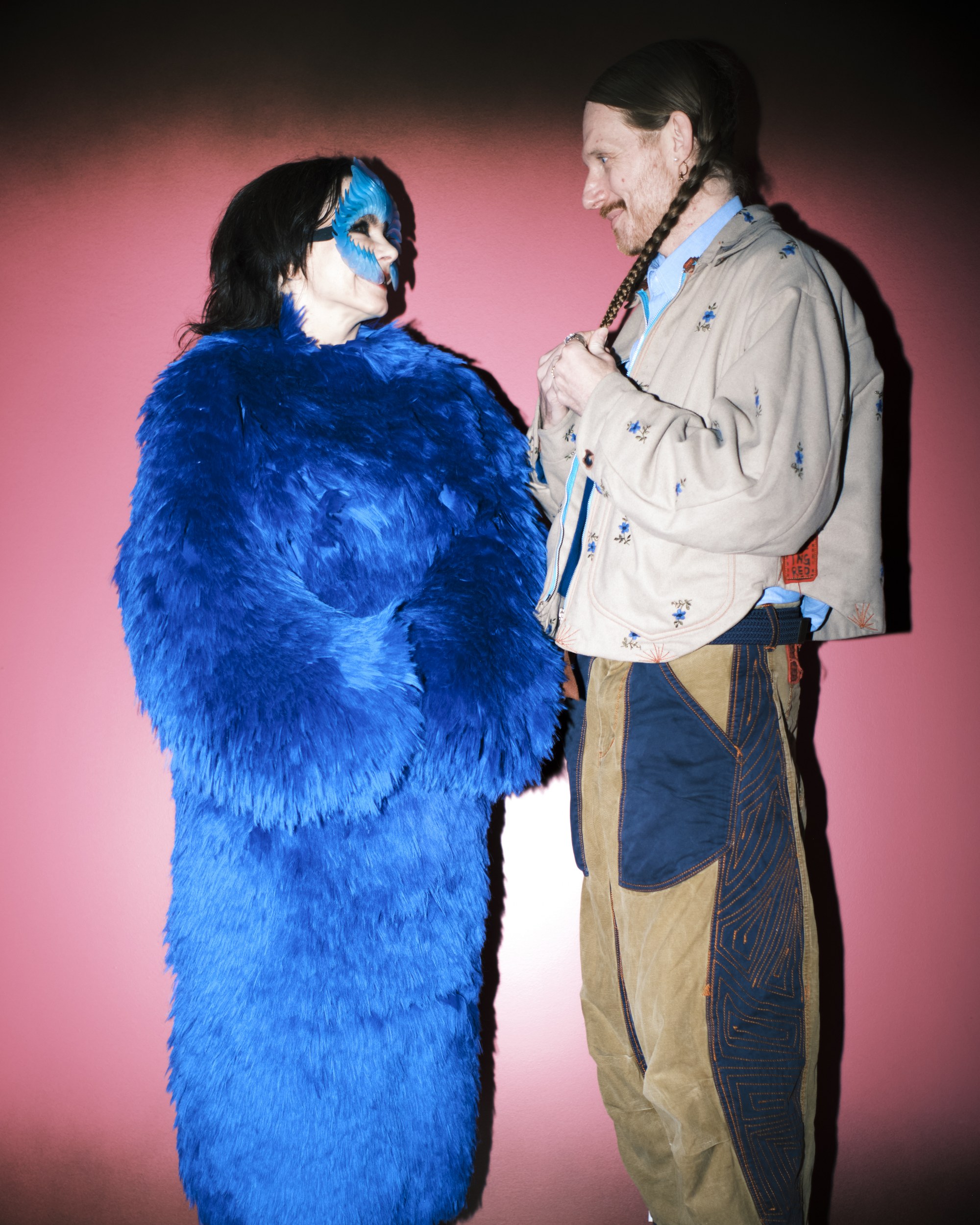
Bottega Veneta has joined the project as patron of Nerve Bloom and partner of the exhibition. Björk appears at the premiere wearing a look by the house, a relationship that reflects an ongoing conversation the brand has cultivated between fashion, moving image, and experimental performance. The creative collaboration is substantive rather than cosmetic. The house has supported the realisation of the work itself.
In her own words, Björk describes the visual language of Nerve Bloom as the product of seven months of close collaboration with painter Natalia Kleszczewska and computer graphics director Natalie Liu. Kleszczewska painted the creatures and backgrounds. Liu shaped the digital dimension of the work. Björk served as creative director, a role she now credits explicitly after years of performing it without naming it. “In the 90s we didn’t credit ourselves with it,” she writes, “but I am starting to understand this better now.” Her framing of the creative director’s function is precise: she brought what she calls the singer-songwriter tradition to the visual work, guiding colour palettes, textures, and environments in the service of emotional precision within the structure of a song.
She calls her broader approach to visual work “sonic symbolism,” sound made visible, a reverse synesthesia. The animated avatars that appear in her videos are, in her description, marionettes in a puppet theatre, connected to what she identifies as Jungian archetypes. The goal is not self-portraiture but something more universal, a figure that stands in for the listener as much as the artist. Nerve Bloom, she says, is a natural continuation of that project.
Running concurrently in Gallery 4 is Metamorphlings, a companion exhibition by James Merry, Björk’s longtime visual collaborator and co-creative director. Merry’s work explores sculpture, transformation, and hand-crafted organic forms, and its presence alongside Björk’s installations creates a coherent visual ecosystem without making either body of work redundant.
The exhibition runs from 31 May through 20 September 2026 at the National Gallery of Iceland, Fríkirkjuvegur 7, 101 Reykjavík, open daily from 10AM to 5PM.
On 12 August 2026, Björk will also stage Echolalia, a one-day solar eclipse rave at Víðistaðatún in Hafnarfjörður, Iceland. The event coincides with a rare solar eclipse, culminating in one minute and four seconds of totality, during which the moon completely obscures the sun and Iceland enters darkness. Björk will perform a DJ set alongside Arca, Sideproject, and Ronja. The event also celebrates the 40th anniversary of Smekkleysa, the influential Icelandic collective and record label. Festival passes include access to the Echolalia exhibition at the National Gallery, along with limited collector’s edition merchandise and publication packages.
What ties these projects together is not a theme so much as a method: Björk consistently builds outward from sound. The installations begin with music and find their visual and spatial forms from there. Her collaborations are chosen for their ability to extend that process rather than decorate it. Bottega Veneta, Genelec, Apple, AIAIAI, Kleszczewska, Liu, Merry: each one enters the work at a point where craft and technology have to solve an actual problem. The result, across the Reykjavík exhibition and the August eclipse event, is a body of work that takes the gallery seriously as a site for sound, not merely as a backdrop for it.