Words by Mia Pflüger
Before a woman in The Odyssey speaks, her clothing has already begun to reveal the role history has assigned to her: Penelope is dressed for waiting. Athena is shaped for wisdom and war. Calypso appears like an island made flesh, Circe like a warning and Helen like the surface onto which generations of men have projected desire, blame and catastrophe. They are characters, but also images that have endured for almost three thousand years: the faithful wife, the goddess, the enchantress, the temptation and the face that launched a thousand ships.
Christopher Nolan’s epic The Odyssey returns to these figures on a monumental scale. Around 5,300 costumes were created for the film, from heavy armour to flowing gowns, veils and jewellery. But scale alone does not make mythology feel alive. A costume must communicate before it impresses. Fabric, color and silhouette tell us about power, longing, danger and memory. The designs do not aim for archaeological certainty. Nolan’s film understands itself as adventure and myth, not a history lesson. What matters is therefore less how people in one clearly identifiable period may actually have dressed than how a character’s inner world can be expressed on the body.
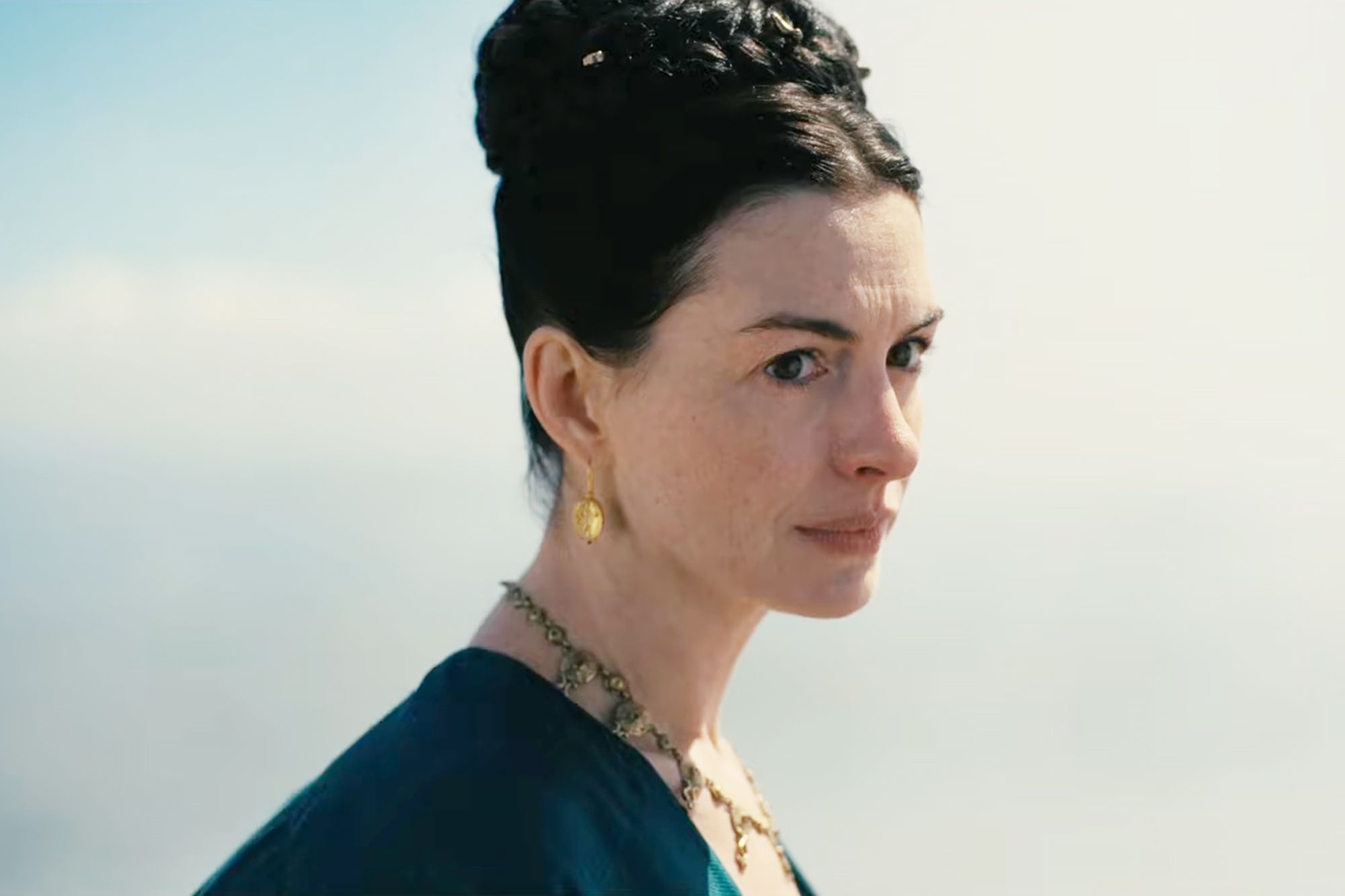
Penelope’s most important garment is one she never completes. While Odysseus crosses seas and faces monsters, his wife remains in Ithaca. To delay her suitors, she promises to choose one of them once she has finished weaving a burial shroud. By day, she works on it; by night, she secretly unravels what she has made. Her loom is often read as a symbol of patience. In reality, it is an instrument of resistance. Penelope understands that fabric can manipulate time. She performs the dutiful wife and queen while quietly dismantling the role others are trying to impose upon her.
Her wardrobe carries the same contradiction. Dressed in rich petrol blue and deep red, she remains visibly regal despite years of uncertainty. Long panels of fabric lend her dignity and movement, while the carefully arranged folds suggest control. Her clothing does not merely express waiting, but the discipline required to keep that waiting from looking like stasis. Getting dressed becomes an act of hope, because every day could be the day Odysseus returns. At the same time, it remains a performance. Penelope must make endurance appear effortless. There is something painfully contemporary in that: women are expected to suffer, hold families together and avoid looking as though the strain has touched them.

Athena poses a different question: how do you dress female power without making it an imitation of masculinity? As the goddess of wisdom and strategic warfare, she rules not only through force, but through knowledge, disguise and precise intervention. In the film, she wears almost colorless linen, wrapped closely around her head, neck and body. The look is modest and stripped back, yet never passive. Its clean lines and controlled draping set her apart from the barren landscape and give her an almost otherworldly stillness. Her authority comes through restraint rather than spectacle. There is no armour, heavy ornament or obvious symbol of divinity. Instead, the costume makes her appear self-contained, precise and difficult to read. Female power is expressed through composure and control: the fabric is soft, but the silhouette remains deliberate. Athena does not need to look physically imposing to dominate the image.
Men in epics are allowed to travel. Women, by contrast, are often turned into the places that delay them. Calypso is almost inseparable from her island. She offers Odysseus intimacy, comfort and immortality, yet her desire is framed as imprisonment because it interrupts his journey home. Her netted dress directly echoes the coastal setting. The dark fabric falls over her body like a fishing net, linking seduction with captivity. What appears open and transparent also resembles something one might become trapped inside.
Circe is her opposite. Her dark, almost unadorned clothing is made from fabrics that appear heavy and rough. Nothing about it tries to turn her into a glamorous sorceress. Muted colors and practical silhouettes give her weight and severity. Where Calypso’s clothing seems to merge with her surroundings, Circe’s presence makes her appear in command of them. Together, the two women show how quickly female power is translated into male danger. One is so desirable that a man cannot leave; the other so threatening that he cannot remain. Their roles are judged according to what their presence does to his journey.
Helen may have the most impossible role of all: to appear beautiful enough for history to mistake beauty for the cause of war. In the film, that burden is expressed not through a conventional white-and-gold goddess image, but through framing, firelight and jewelry. Layered beads and hair ornaments draw attention to her face, turning her into an image before she is allowed to become a person. The effect is both regal and unsettling. She looks precious, almost sacred, but also displayed – her beauty treated as something public, interpreted by everyone around her. Helen does not simply wear jewelry; she wears the myth others have built from her face. Lupita Nyong’o’s dual role as Helen and Clytemnestra sharpens the contrast. Helen is presented to the gaze, while Clytemnestra seems capable of returning it.
The film’s first images prompted debate over its unconventional visual language, with most criticism directed at the men’s armour: dark materials, unfamiliar helmets and designs some viewers considered closer to fantasy than the Bronze Age. The women’s costumes largely escaped the same backlash, perhaps because they are more readily read as emotional and symbolic rather than strictly historical. That symbolic clarity, however, comes with its own risk. Costume can shape how we read a character; a heavy fabric alters posture, a veil controls visibility, a rigid silhouette creates distance, but it should never define her completely. The strongest designs offer an entry point into these women without reducing them to the archetypes they have inherited.
Against this backdrop, the press tour becomes an extension of the story’s visual language. Zendaya and Law Roach do not recreate Athena’s onscreen wardrobe, but reinterpret its restraint, authority and otherworldliness through contemporary fashion. Pale draping, metallic accents, hoods and sculptural silhouettes move between goddess, warrior and statue, while the looks grow steadily more monumental across the tour. Soft folds and gold details give way to Schiaparelli’s moulded bodice and, finally, the winged Matières Fécales gown, transforming Athena from a character into a fashion image built for spectacle. That shift also reverses the usual hierarchy of the epic. Onscreen, costume gives the women distinct visual identities without allowing them to disappear into archetype. On the red carpet, those same archetypes are deliberately enlarged and made central to the campaign. A story traditionally organized around one man’s journey is promoted through the women who surround it, allowing them to shape its most memorable public images before audiences even enter the cinema.
Each premiere look becomes another adaptation. Nolan translates Homer’s epic into cinema, costume gives its women a visual language, and the press tour carries that imagery into the present through fashion. Penelope’s weaving, Athena’s pale restraint, Calypso’s netting, Circe’s dark textures and Helen’s heavy jewelry endure because every era dresses these women according to what it desires, fears and expects from them. Odysseus may be the one allowed to wander, but the women carry centuries of symbolism on their bodies. The journey may belong to him. Yet they are the ones who understand how to dress for eternity.