The diamond is bright, but it’s the gold line around it that makes you look twice. A bezel setting follows the stone’s edge with a metal rim, giving an oval a continuous outline. You can read the shape even before you notice the smaller flashes inside it.
That’s an interesting starting point if you love jewellery with a definite form. Perhaps it’s the curved buckle on an old belt, or a broad cuff you wear with almost everything. A diamond ring can belong in that company, too.
Let the frame show
GIA’s setting guide distinguishes a full bezel, which surrounds the stone’s edge, from a partial bezel, which leaves sections open. For this look, concentrate on the uninterrupted border of a full bezel and how much of it you can see from above.
The Margot ring in Lily Arkwright’s lab diamond jewellery collection pairs an oval bezel with a plain 2.00 mm band in 18ct yellow gold.
Look at the rim itself when comparing designs. A narrow border traces the stone; a broader one gives the metal more presence. With yellow gold, there’s a clear colour change between the frame and a colourless-looking diamond. That edge is part of what you’re choosing.
Grey tailoring, one gold curve
Try the oval with a charcoal trouser suit and a white ribbed vest. The long lapels and pressed creases give you plenty of straight lines already. The ring adds a small curve, while the yellow gold breaks up the grey without introducing another fabric or print.
Keep a pair of rounded gold hoops on if you wear them. Repeating the curve gives the ring company without making the jewellery identical. A square-faced steel watch would create a different balance: a pale rectangle at the wrist, a warm oval on the hand. You can enjoy both shapes in one outfit.
Use a full-length mirror to see how the ring sits within the outfit, alongside the hoops or watch. Then look at your relaxed hand from your usual viewing distance to judge the bezel’s width. Is it a fine line around the diamond, or a substantial part of the ring’s outline?
Take the same ring somewhere softer
Keep the yellow-gold oval and change into a loose ink-blue dress in crinkled silk. Against a fabric that falls in folds, the ring’s defined edge becomes a small point of structure. This is where a simple setting can be especially satisfying: you have a clear shape on your hand while everything around it moves.
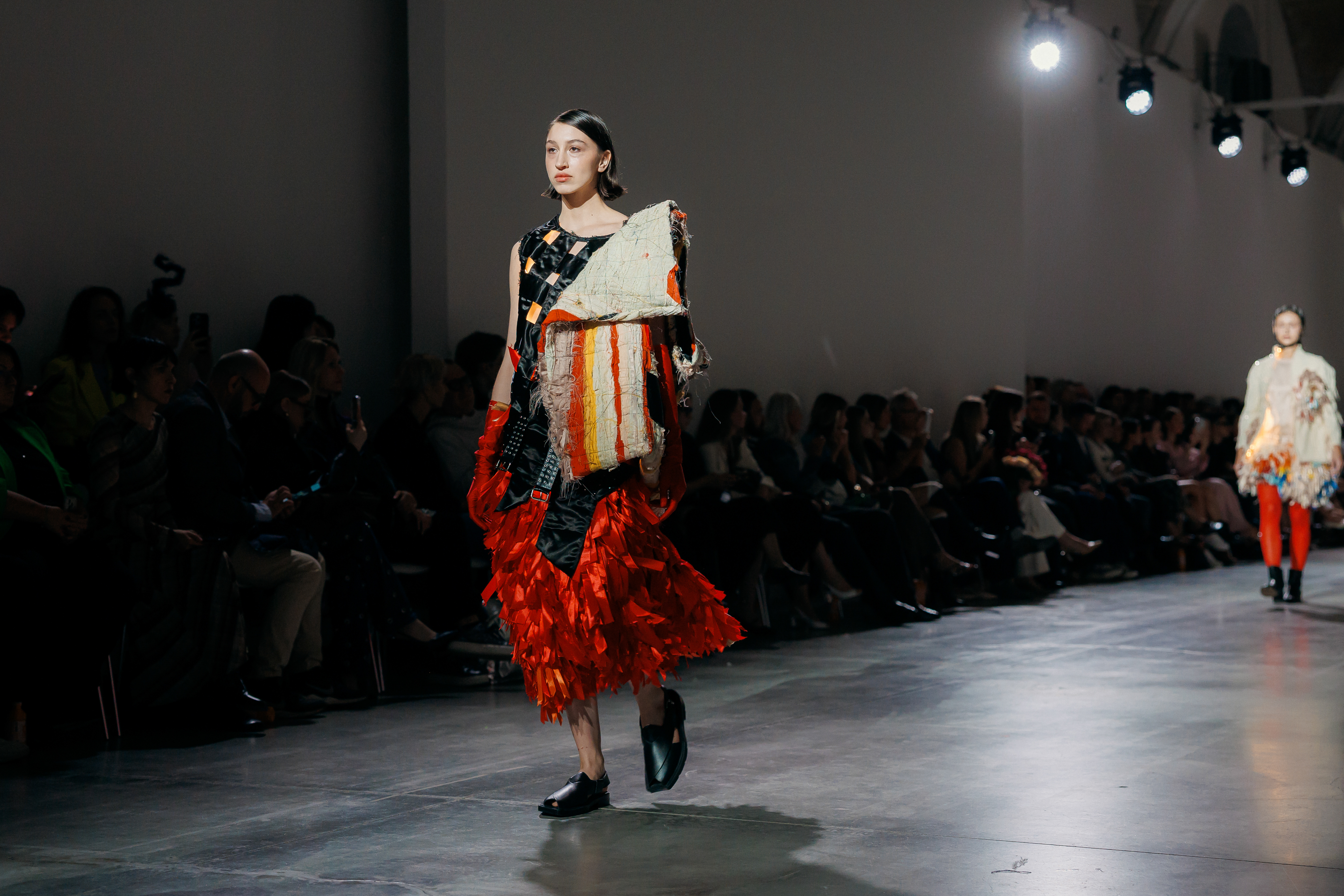
Flanelle’s conversation with Dömd explores geometry and tactile fabrics in clothing. Bring that attention to shape into your own outfit: smooth gold beside a crinkled sleeve, for example, makes the difference between the surfaces easy to see.
For a fuller jewellery look, add a broad gold bangle on the other wrist. The bangle supplies a larger area of metal, leaving the oval as the more detailed element. If a chain at the neckline is already part of how you dress, keep it in view. The outfit doesn’t need to become bare for the ring to make sense.
Check the shape you’ll actually be wearing
When trying a ring, ask for the complete setting’s length and width, including the bezel. Those measurements describe the outline you’re responding to. The stone’s dimensions alone won’t tell you how much space its metal frame adds.
Check the image labels as well. Margot’s yellow-gold oval listing identifies a 2ct centre in the product photographs and a 4ct centre in the model image and video. A picture can be an accurate representation of the ring while showing a different size from the one you’ve selected.
The top view also leaves a question unanswered: how high does the ring sit? Open the profile photograph and try the design with your hand relaxed. GIA notes that a bezel’s smooth edge is less likely to catch on clothing, but that doesn’t make every bezel ring low-set. Ask about the particular construction.
Then return to the outfit that first made you curious about the ring. Put the jacket back on, or let the blue sleeve fall naturally. You may discover that the gold outline was the detail you wanted all along. Give it room to be seen.