Paris has never been short of places to spend the night. But there is a difference between a venue and a myth, and the Bus Palladium has always belonged to the second category. On September 30, 1965, a 22-year-old named James Arch flicked on a red neon sign above a white building at 6 rue Fontaine and opened a club that would, within ten days, receive Salvador Dalí and a black panther. Serge Gainsbourg would write a song about it. Jane Birkin would call it “a mental laboratory.” It would survive a police closure, multiple reincarnations, Patti Smith, Pete Doherty, and 57 years of Paris nights before finally shutting its doors in July 2022.
In 2026, the neon comes back on. And behind the resurrection: Studio KO.
A Street That Has Always Known What It Was Doing
Rue Fontaine is the kind of address that makes historians nervous because there is too much to explain. Toulouse-Lautrec at number 19. Degas at number 21. Django Reinhardt playing at La Boîte à Matelots at number 10. Breton, Éluard, Aragon and De Chirico inventing Surrealism at number 42. Sidney Bechet on clarinet at the Alcazar Fontaine, Alberta Hunter singing the blues. The street functions less like a location and more like a recurring argument that Paris keeps winning.
Studio KO’s Karl Fournier and Olivier Marty understood the weight of that context before they drew a single line. Their previous commissions include the Yves Saint Laurent Museum in Marrakech and the renovation of the Château Marmont in Los Angeles, two buildings where history is not a decorative element but a structural one. The Bus Palladium required the same instinct: not to erase or museify, but to let the past show through the present like layers of light through old glass.
The approach Fournier describes is one of “contrasts” and “impertinence.” Two words that sound light until you understand what they cost.
Going Down Before Going Up
The building at 6 rue Fontaine is only two stories tall, a gap in a line of taller constructions. What Studio KO did with that constraint is either an act of engineering madness or a perfect metaphor, depending on how you look at it. They dug 14 meters underground to create 12 levels, four of them below ground. The idea was not to expand the building so much as to give it a subconscious: layers where past and present physically overlap, where you can sleep one floor above the dance floor that Gainsbourg once used as his office.
This is the move that defines the whole project. The hotel does not sit on top of the club’s legacy. It grows through it.
The minimalist sandblasted façade, engraved with discreet geometric patterns that echo the language of the original building, gives nothing away from the street. You would not know, walking past, that below your feet a stage is being fitted with one of the best L-Acoustics sound systems in Paris, that a monumental screen and sculpted lighting are being assembled, that a mezzanine for 200 people is taking shape in a room that once made a young Gainsbourg reach for his notebook.
The Interior: Concrete, Cork, and Klein Blue
Inside, Studio KO works with a 1960s and 70s visual grammar that never tips into pastiche. The distinction matters. Pastiche reaches for nostalgia. What Fournier and Marty have built reaches for something closer to physical memory.
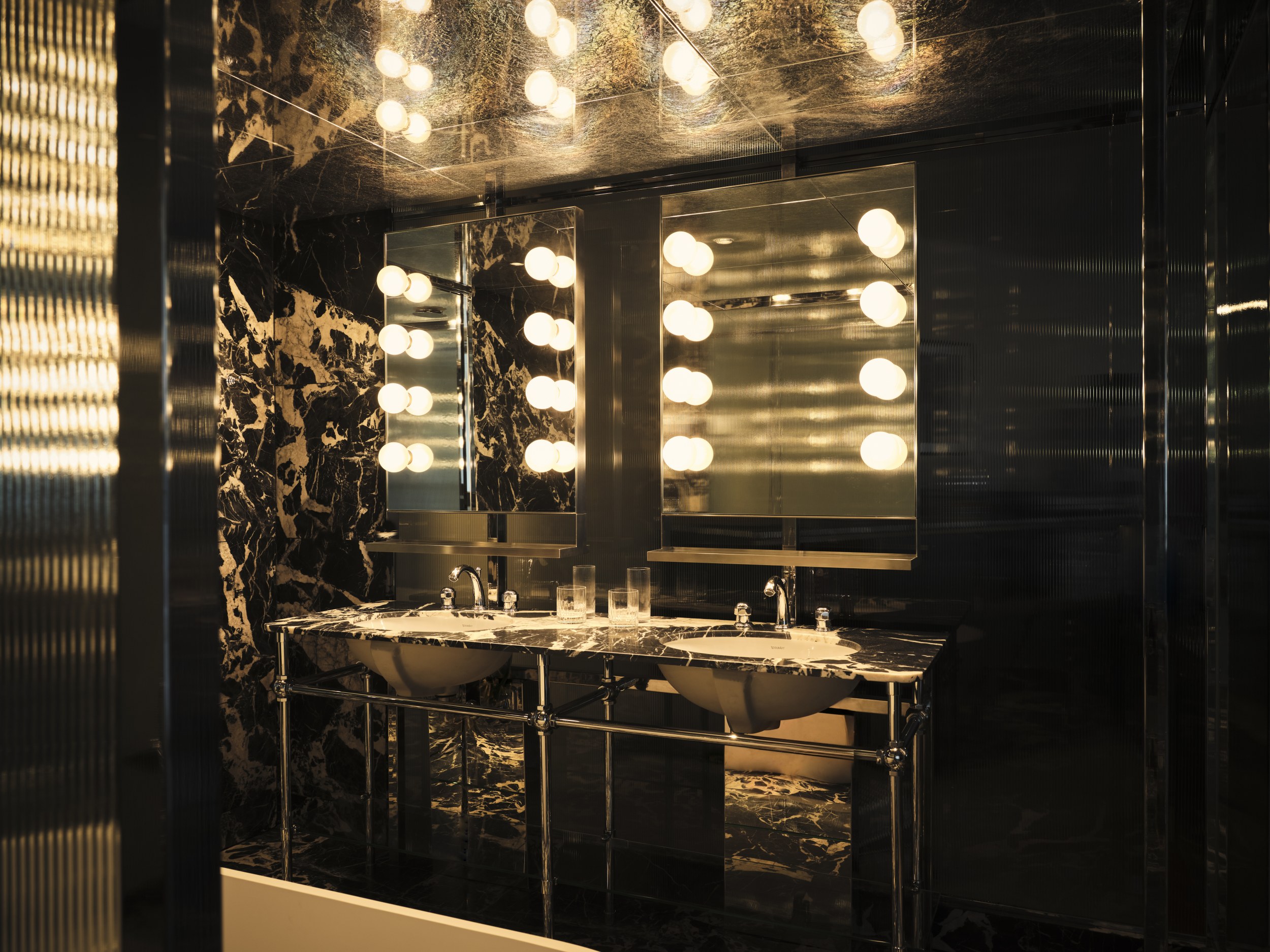
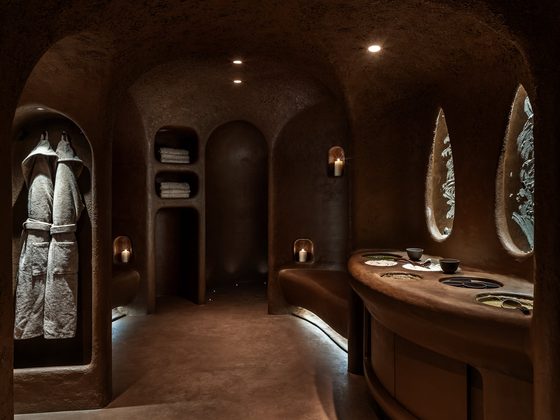
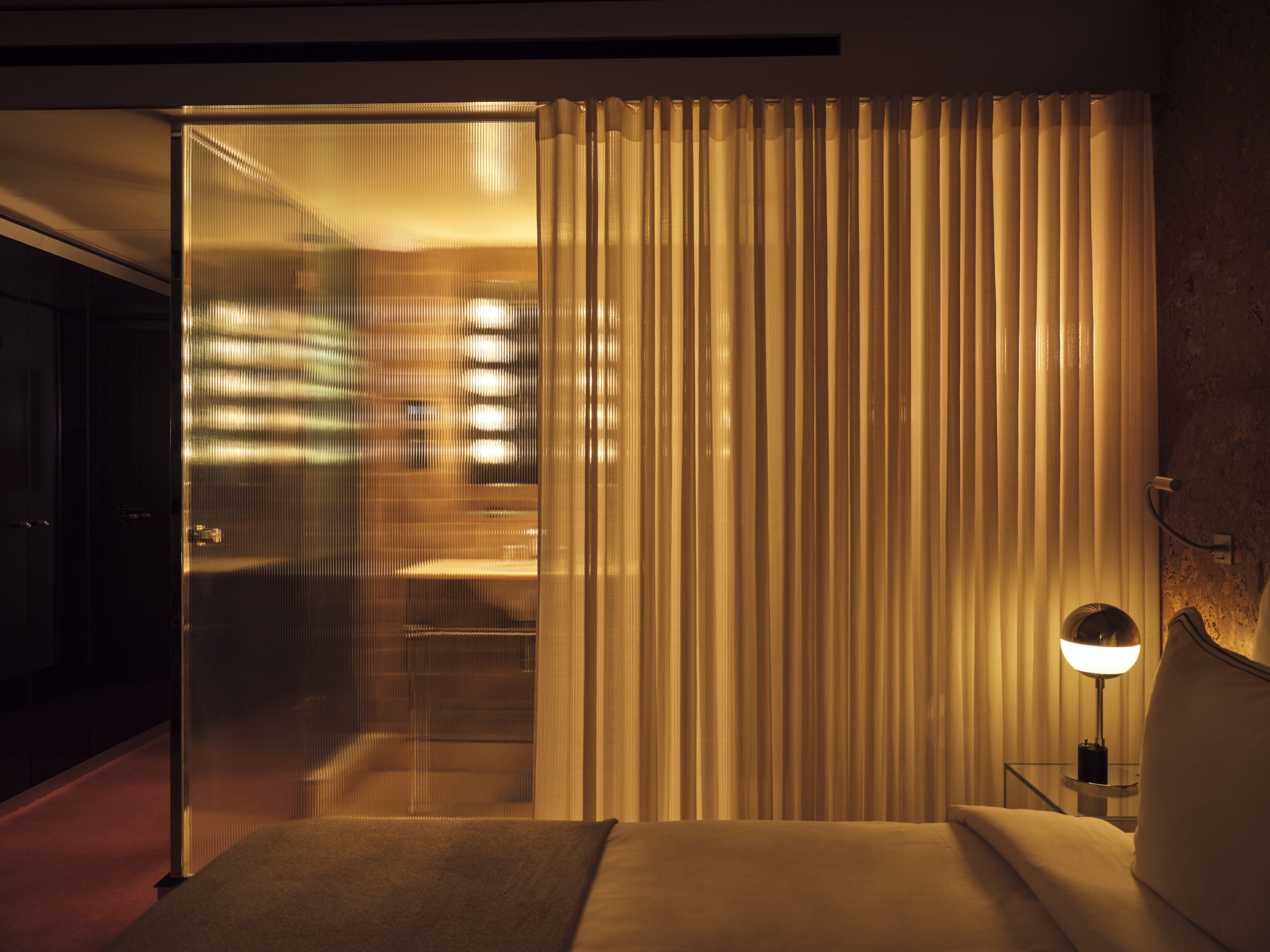
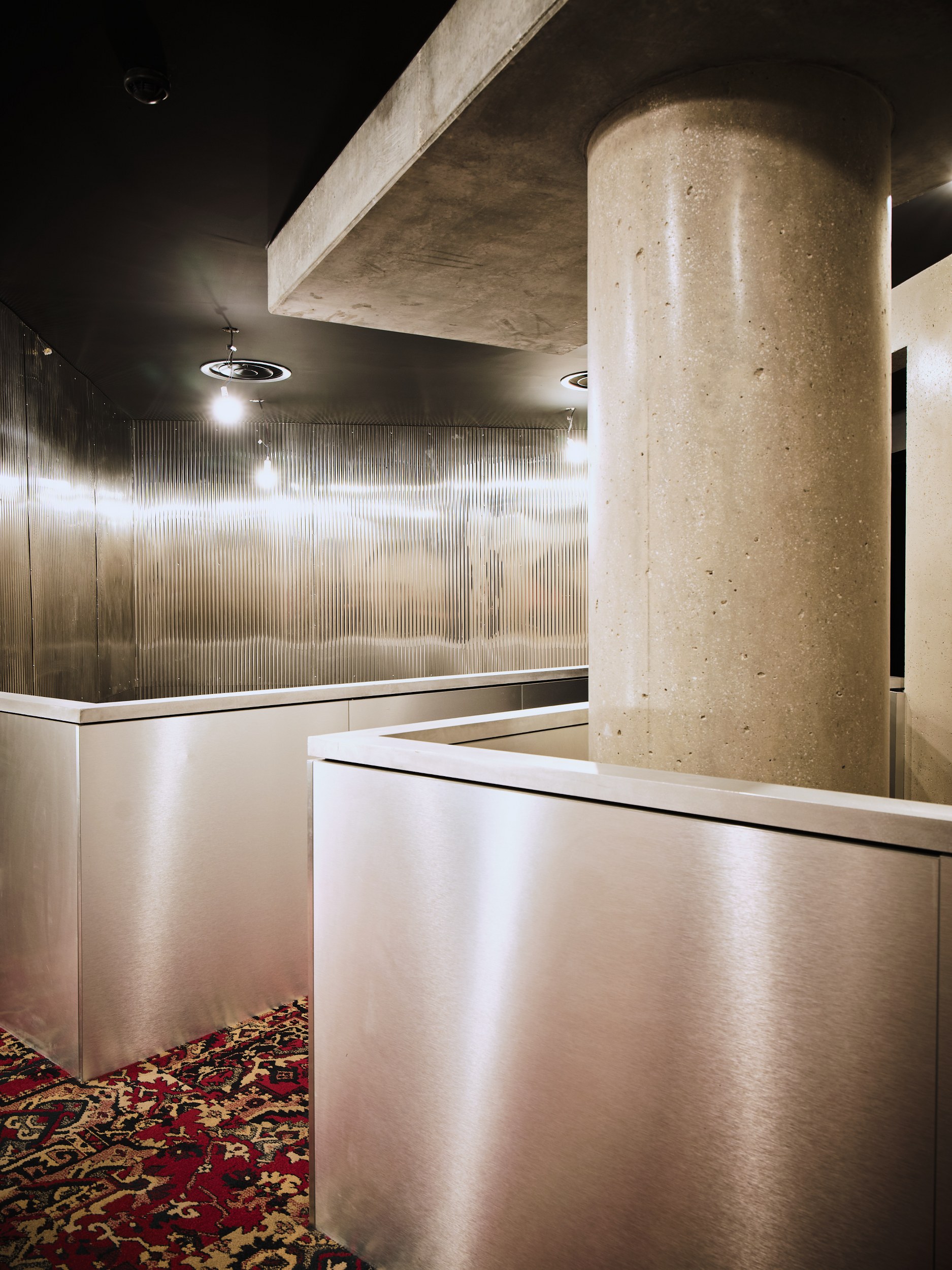
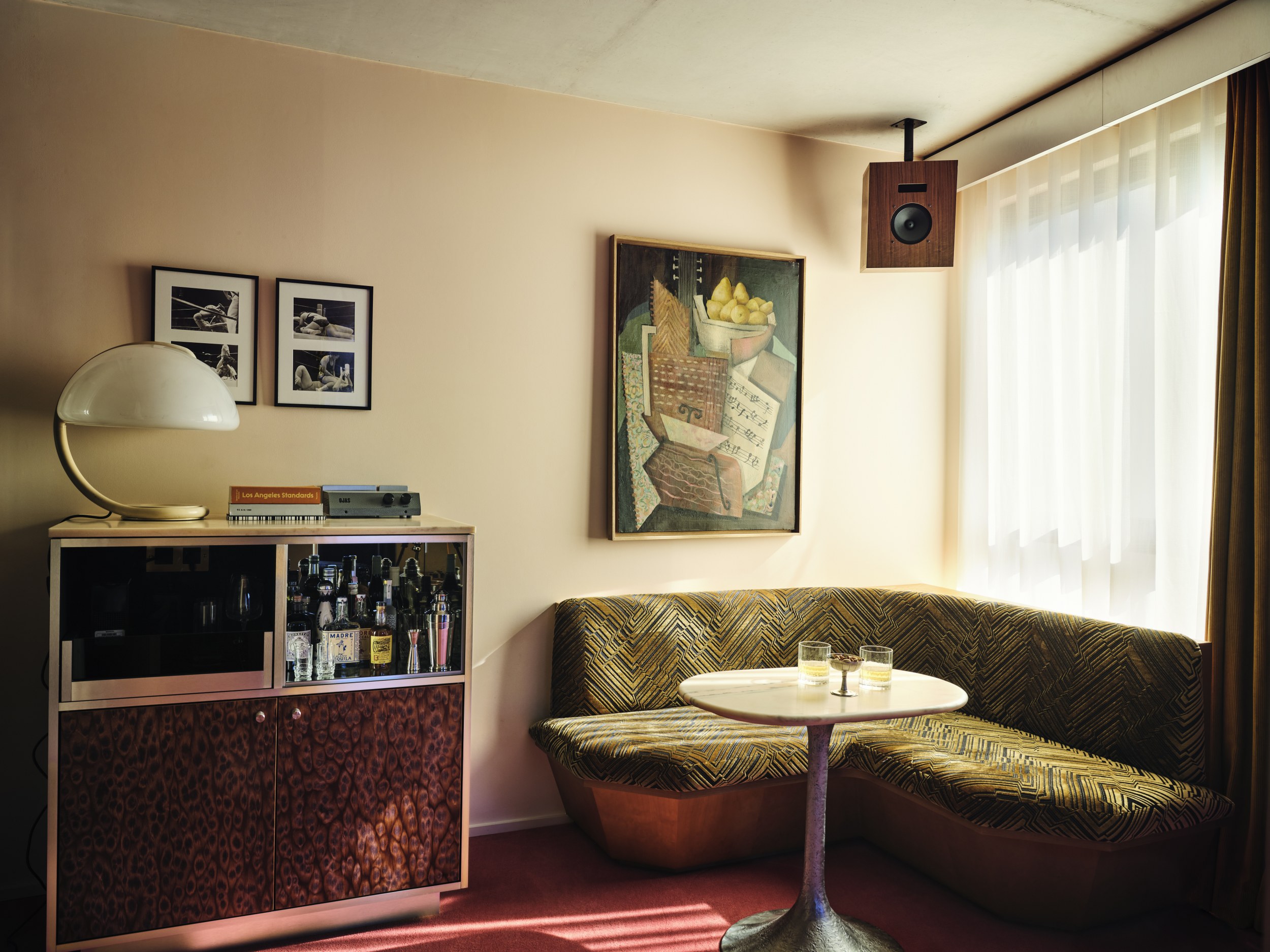
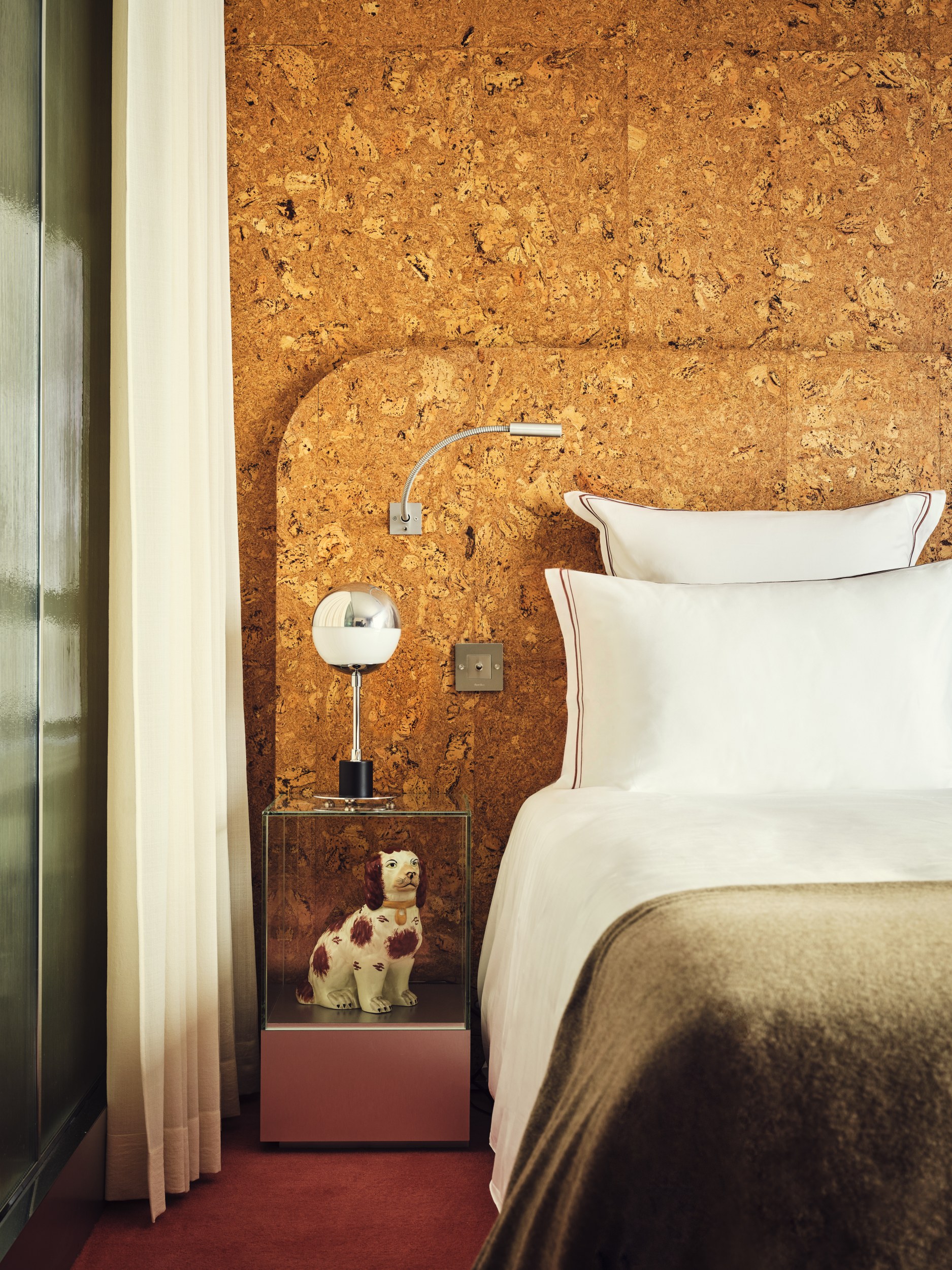
Raw concrete ceilings. Enveloping cork walls, a material Studio KO had previously explored in Francis Ford Coppola’s New York apartment. Powder-pink carpeting. Bathrooms tiled entirely in Klein blue or dusty pink, appearing behind semi-transparent veils like something half-glimpsed on a film set. Corduroy curtains that reference the uniforms of seventies film crews. Switches designed to recall vintage amplifiers. Door handles with perforation patterns taken from microphone grilles.
None of this is accidental. Each detail carries a function beyond its function. The door handle is not just a door handle. It is an argument about what kind of place you have entered.
Bedside tables are transparent cubes containing works by contemporary artists and found objects: stacked old audio cassettes, book collections, miniature buses. The curation was handled by Ballade Sonores, the neighbourhood’s iconic independent record shop, by L’Œil de KO, a decorative arts and crafts gallery, and by collector Antoine Billore. No two rooms are alike. Each object was chosen to live in a specific space, not to be displayed in it.
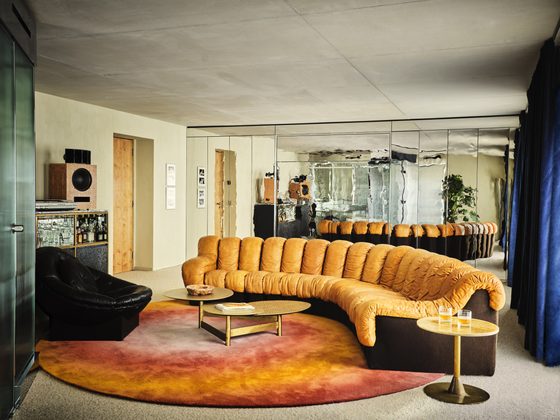
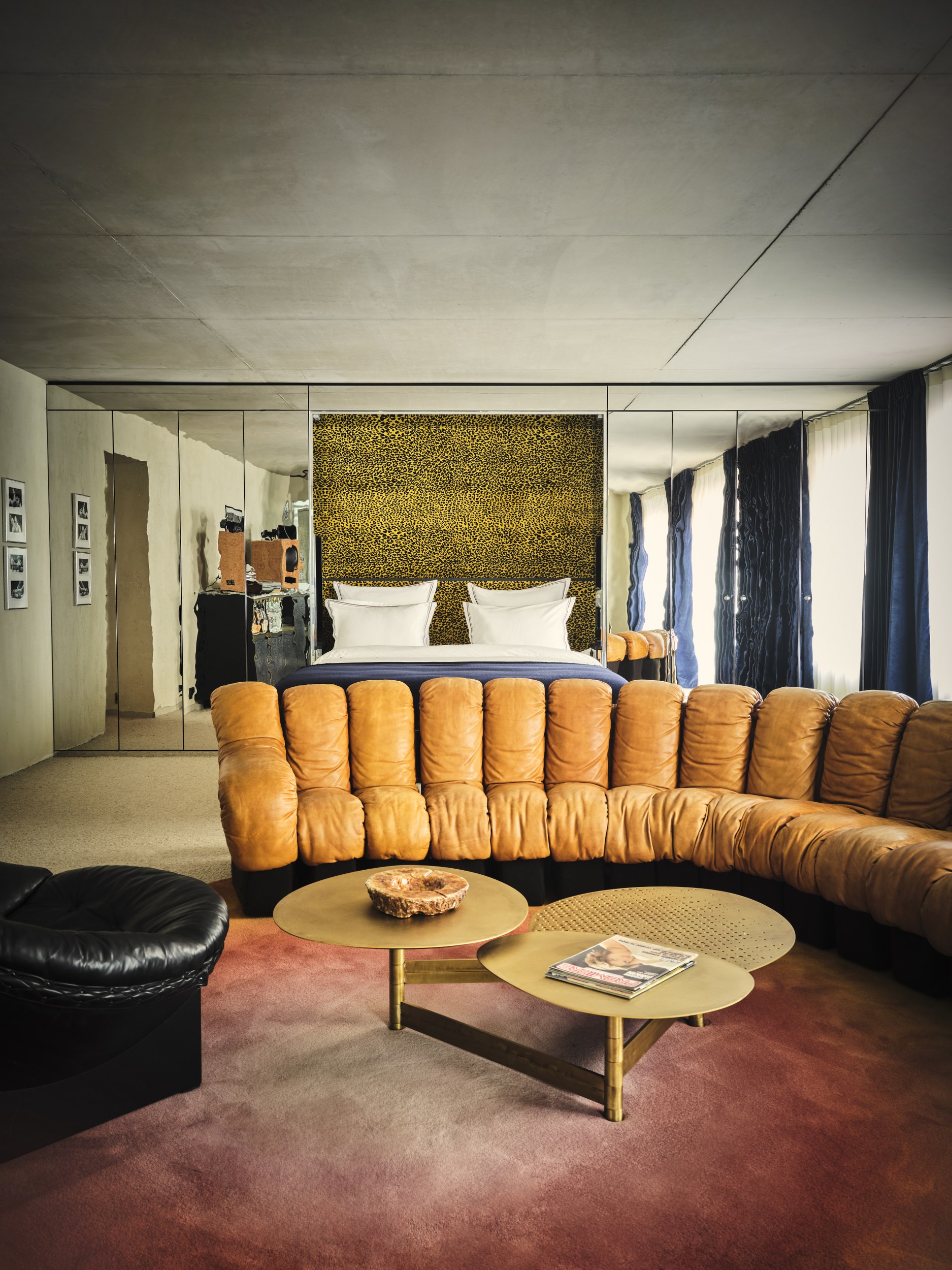
The Dalí Suite is its own statement. The modular DS-600 De Sede sofa, sourced along with most of the hotel’s furniture. A foldaway bed set within a mirrored alcove. A balcony that overlooks the red neon sign. It is the kind of room that makes you understand why Dalí, upon first entering the original club, reportedly told Arch: “Whatever you do, don’t change a thing. You have here an exceptional work of kitsch art.”
The People Around the Table
Architecture is only one part of what makes the new Bus Palladium worth watching. The project has assembled a cast of collaborators that would have made the original James Arch envious.
Nicolas Saltiel, founder of the hotel group Chapitre Six, brings a portfolio that includes Hôtel La Ponche in Saint-Tropez, Cap d’Antibes Beach Hotel and La Folie Barbizon. His practice has always been to activate a place’s specific history rather than work around it. He describes a hotel as “a narrative. A story that awakens the senses, unfolds a palette of emotions and, if successful, elevates you.” He knew the Bus from the inside, having worked there during the MOMA group years alongside Benjamin Patou. The project is personal in a way that makes a difference.
Caroline de Maigret, former model, Chanel ambassador and co-author of How To Be Parisian Wherever You Are, serves as artistic director and curator. She has created four exclusive playlists, broadcast on Ojas wooden speakers in every room, ranging from the intimate and sensual to the languid and late-night. She has also designed staff uniforms in collaboration with Husbands: corduroy, precise cuts, slightly flared high-waisted trousers, slim ties and lacquered red belts. The deep red runs through the hotel like a leitmotif of the sign and everything it once promised.
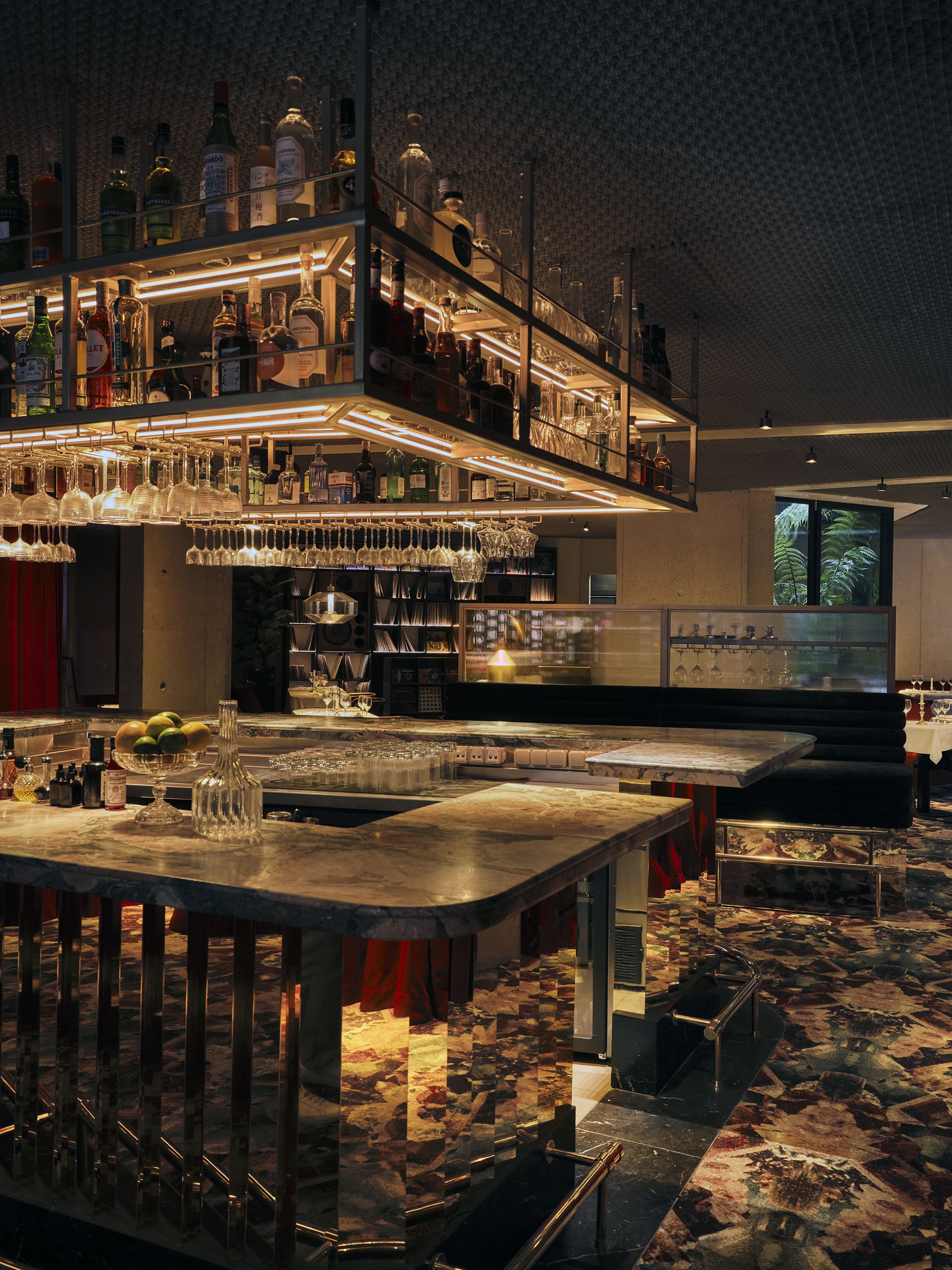
Chef Valentin Raffali, trained alongside Meilleurs Ouvriers de France, runs the restaurant with a menu that is deliberately concise: smoked white asparagus with sweet vernal grass, amberjack with sorrel, Lozère lamb saddle, morel vol-au-vent. He works directly with fishmonger Viot, butcher Andrès, and Terroirs d’Avenir, sourcing as locally as possible. The menu changes. The discipline does not.
And then there is Lionel Bensemoun, former owner of Le Baron, handling the artistic direction of the club itself. “We need moments where we don’t look at a screen, but into someone’s eyes,” he has said, “because the night has changed.” The programming has no fixed style, which is precisely the point: open, varied, built on a love of music rather than a commercial formula. Discovery concerts and cabaret evenings fill the early hours before the turntables take over at midnight. The club runs Thursday to Saturday, midnight to five in the morning, with privileged access for hotel guests.
What Studio KO Actually Built
Strip away the mythology and the cast and the history, and what Studio KO has delivered is a very specific architectural argument: that a building can hold multiple lives simultaneously, that you can sleep, dine, drink, and dance in the same address without any of those activities diminishing the others.
The 35 rooms and suites sit above a bar, a restaurant, a rooftop and an underground stage. Music plays 24 hours a day. You can descend to the club in your pyjamas. You can come up for breakfast at dawn while Paris is still quiet. You can eat dinner facing a full wall of vinyl records, including the historic collections of James Arch and Jean-Charles Dupuy, the DJ who played there from 1979 onward and later wrote a book about those years.
Jean-Charles Dupuy once said that in the late 1970s, Paris nightlife revolved around three places: Le Palace, the Élysée Montmartre, and the Bus Palladium. But only the Bus embodied the rock spirit. Studio KO has not tried to recreate that spirit. They have built the conditions for it to return on its own.
The red neon sign is lit again at 6 rue Fontaine. The rest, as it always has been on this particular street, is up to whoever walks through the door.
Photos by Matthieu Salvaing