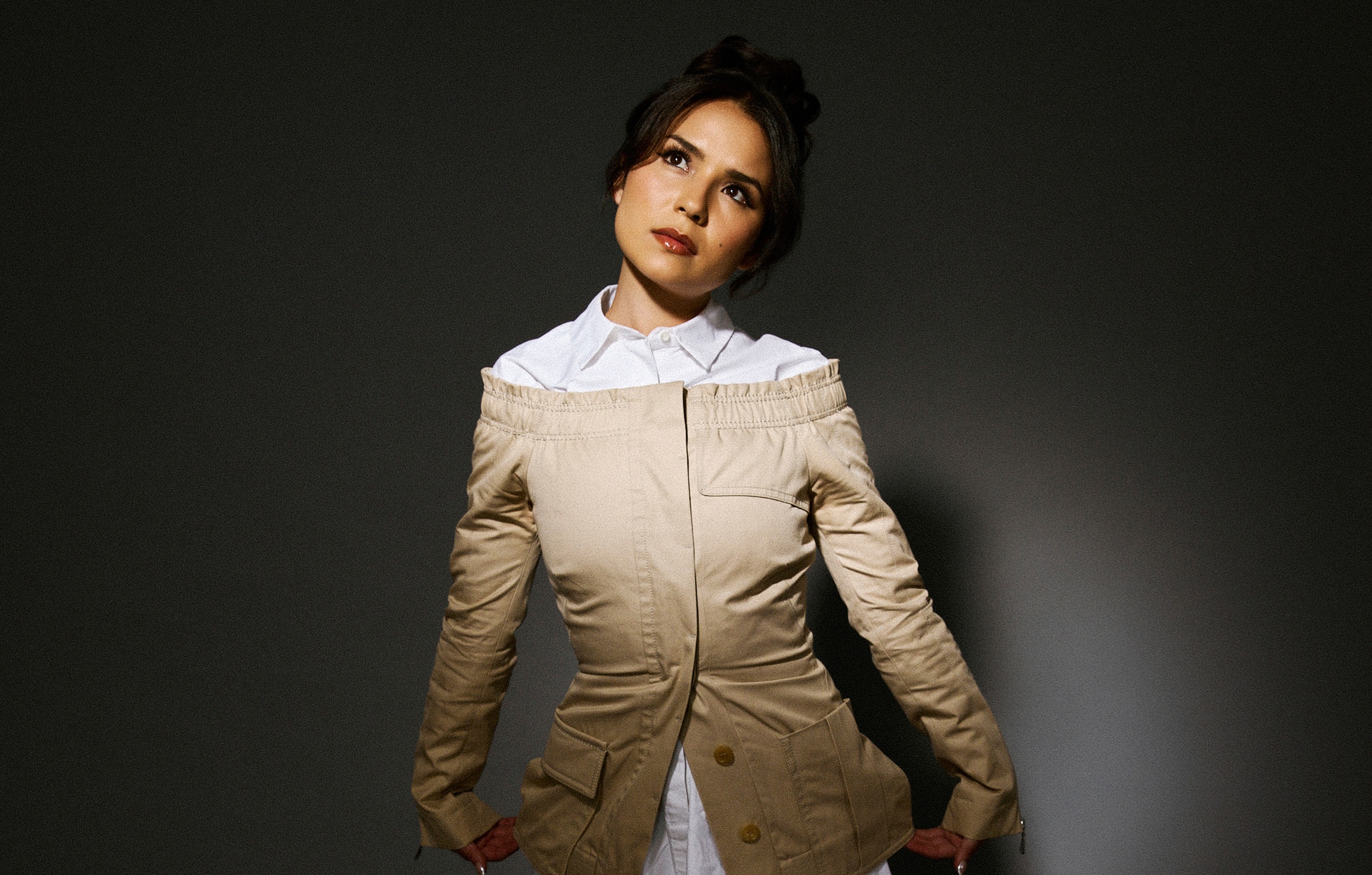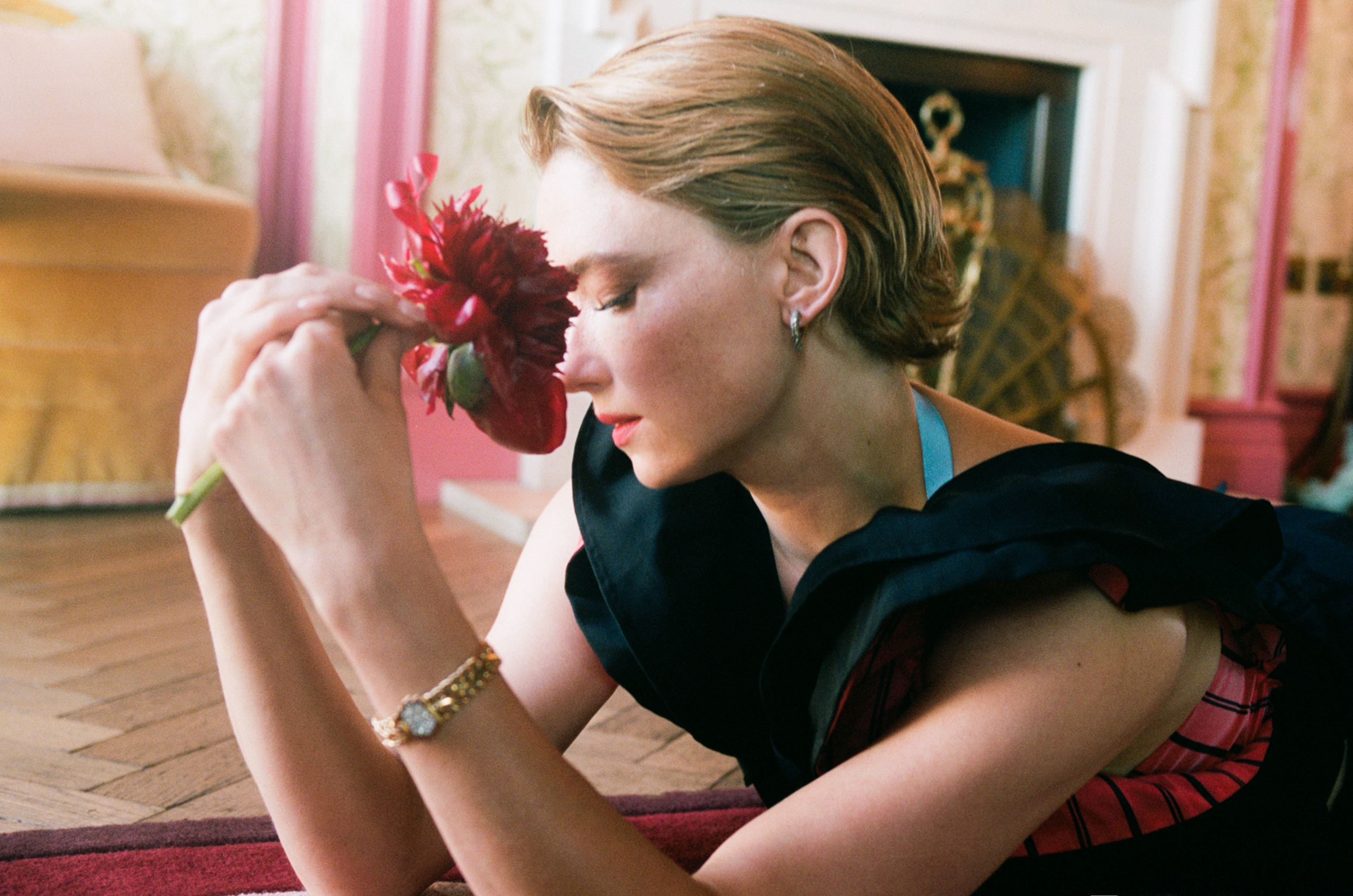
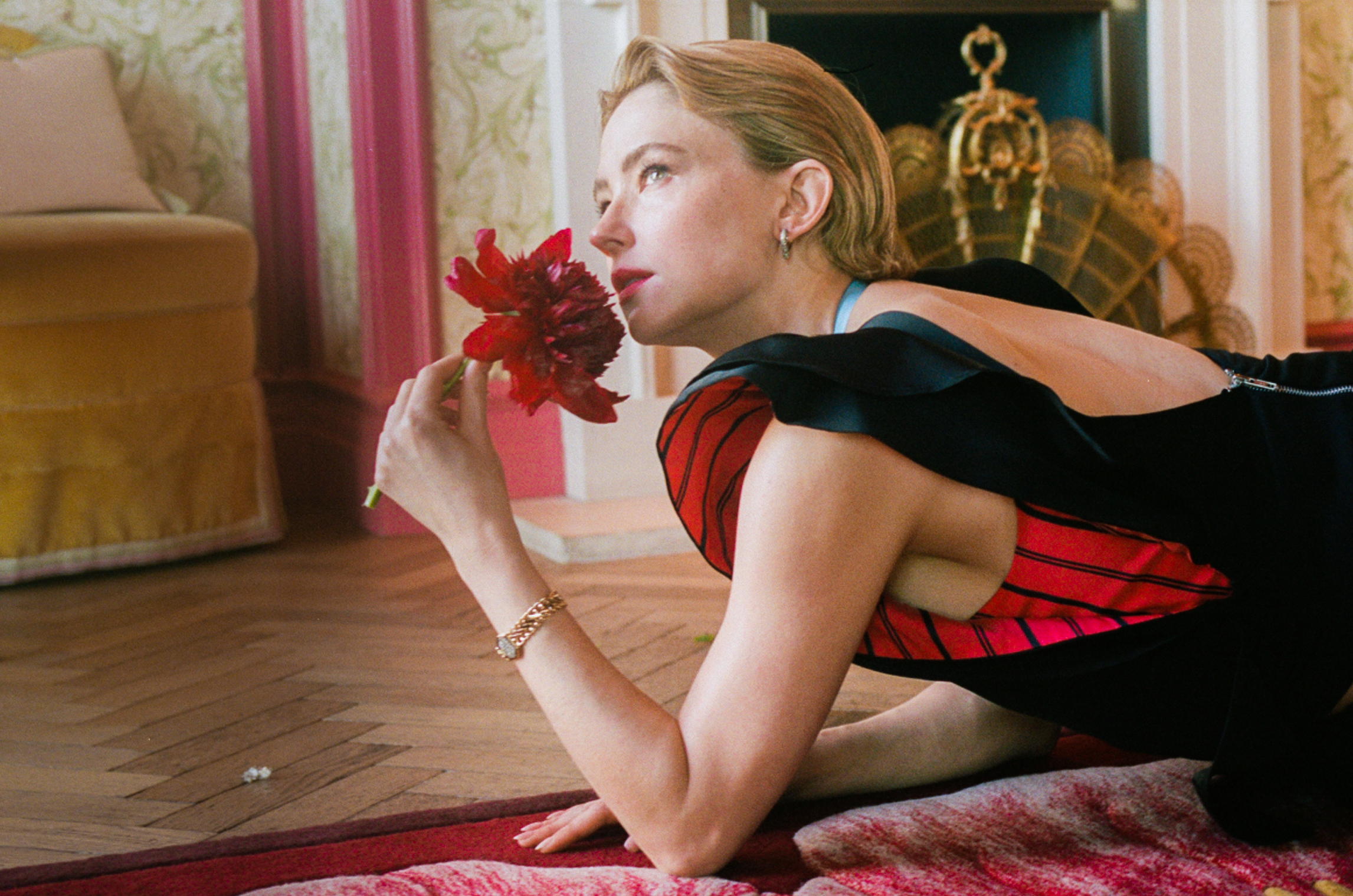
A woman. A mother. An actor. Haley Bennett is not so easily defined, even to herself, yet she is all of the above. When describing who Haley Bennett is, she posits it to be a mystery. She doesn’t know how to define who she is. But she argues that our identities are constantly being shaped in real time. Taking a trip down memory lane, she brings me to her recent visit to Scotland where nature’s beauty took hold of her. Growing up as a nomad with a creative soul, Haley has always had a close relationship with nature. A place where she feels most herself, where she feels free. When nature is healing, Haley is at ease, “It deserves and needs to be protected. I was in Scotland and I thought to myself. This is something you can’t put a price tag on. The experience of when you find a place where there’s just vast wilderness, and everything feels like it’s in its right place. I love that.”
Sitting with Virginia by the river, Haley stuck her hand into the moss but what she didn’t expect was the euphoric feeling it gave her. In a manner of speaking, nature is a lot like acting for Haley. I suppose art is euphoric in its own way. She agreed wholeheartedly. Perhaps that’s why it can feel so addictive. The pleasure is immense, and artists like Haley want to indulge in that search for pleasure. For her, to create is to forget yourself. A state that she is constantly trying to achieve. That’s when I realised what she meant, like nature, you can’t put a price tag to art either.
Virginia Woolf is one of our most important and treasured modern writers. Not only for the period in which she lived, during the early 20th century but for how her novels carried over a timeless quality and universal message that there’s more to women if you take a closer look, pioneered by her stream of consciousness styled narratives. Her writing was pivotal in shaping the feminist movement across decades and is still cited now. Night and Day was one of her earlier novels, difficult to conceive during a period of struggle with her mental health, and to this date no complete manuscript exists. But what’s fascinating is how this novel would go on to be adapted into a film over a century later. A story told by a woman, now directed by a woman (Tina Gharavi) and led by a woman, herself, Haley senses that female solidarity across time as something she aspires to and enjoys. She says, “I think that is partially because we are in some ways living the same experience. Women know secrets about each other. We understand this kind of universal struggle, the insecurities, the fears. The impossible quest of balance and that transient nature of being and experiencing. That is one of the reasons I love working with women, there’s a shared language that is very much expressed in everything Virginia Woolf has written.”
I ask how she sees Virginia Woolf. Without hesitation she offers high words of praise, “Intelligent. Ephemeral. Timeless. Courageous. Rebellious. Funny. Full of contradictions.” I did laugh throughout the film when I saw it at the opening day SXSW London premiere in Barbican, so she is spot on about Virginia’s humour. But you can tell she means a lot to Haley. A woman that has rejected being defined or boxed into specific labels, someone as ambiguous as she is determined to find her place as a woman reflected from the stars she gazes at in the night sky. An all too familiar feeling for Haley, who constantly searches for that loss of self. A greater feeling hard to define, only able to experience.
Virginia Woolf’s Night and Day is one of many things, but it was certainly timely. A commentary on social class, ambition, love, the nature of marriage and what these were all perceived to offer then. People sometimes forget marriage was seen as a business deal. Sure people fell in love, but that wasn’t a necessity for the ritualistic contract to take place. In those days, women were often seen as expected to give up their dreams and ambitions to settle down for marriage, become a housewife and take care of the family. Haley believes Katharine isn’t running from love, so much as she feels love and marriage to be destructive. She argues, “There is a loss of self, not the one that I am looking for, the transcendental kind but you are sacrificing yourself.” Harsh words but she has a point. Love and marriage back then was often a transaction of compromise and inevitability, where women gave away their own future and even rights to satisfy the family tradition, and bind themselves to a man who would pursue the future for the both of them. That loss of agency is threatening to be Katherine’s fate, “In some circumstances, you are giving a part of yourself over. You are surrendering yourself to another person. Men of course do the same thing, but it’s different for women.” Even if times have changed, that expectation of women hasn’t. “There’s so much to juggle, even in 2026. My reality is I can’t do it all, and sometimes I just feel like I want to, have to give up. I’m going to give up and stay at home and be the wife, and maybe that is the easier solution. We get spread so thin. It’s a luxury to have the support of a man to say you go live your dreams, and I will take care of it. But of course, the man is also trying to do the same thing and if you have children, it’s a different story.”
It’s interesting she says that, because looking back in history, usually when a man aspires to be ambitious or leave the family home, they are encouraged or that is simply the standard, but when it comes to women, it’s the opposite. You’re seen as sacrificing yourself or compromising the family, as we see with the relationship between Katharine and her dad. Knowing that times have changed, of course, not that so much progress has been made, but there’s some progress. I ask if Haley feels that progress. She does seem to think so. “Women undoubtedly have way more opportunities, and that’s because of women like Virginia Woolf, like Katharine Hilbury. My grandmother, your grandmother, my and your mothers, and hopefully you can continue that legacy.” Yet even with that change, there is still frustration in the air, that there’s not enough change, “I think women were told that they couldn’t do it all, and now women are expected to do it all and make it look easy and do it with a smile, despite the fact that we’re told we should be grateful for these opportunities. This is one thing that drives me crazy when I read critiques of women’s work, especially through the eyes of a man, and I go, have you done it? Have you lived this? Again, sometimes the weight is so heavy to try to do all things and encompass all things and be ambitious. Which is why I say to you, can you choose what balance looks like? If you’re lucky enough to think that these are antiquated concepts, then you probably are a man.” As a man, what she said wasn’t wrong. Expectations or not, that’s the reality for women.
When Haley mentioned women having to smile, it brought me back to when I went to the Venice film festival 2 years ago. It was the day of the Beetlejuice 2 premiere and I remember there was a photo call for the cast with Jenna Ortega and Winona Ryder, and photographers were asking them to take off their shades and smile. Winona seemed uncomfortable to do so, and I noticed Jenna telling her she doesn’t have to if she doesn’t want to. There was that intuitive support for each other. “Camaraderie”, Haley says. She’s exactly right. Beautiful camaraderie that was. It’s often the expectation for women to look a certain way or appear more appealing. Whereas that attitude doesn’t really extend to men. Haley shares my opinion, “I think women’s choices are critiqued in a much harsher way than a man’s choice. The woman is always blamed for the choices of a man. They’re not only blamed for their choices, but they’re also blamed for the choices of a man, which is crazy.”
She’s getting to a larger point here about the nature of a patriarchal society, one I think directly relates to her character Katharine. Her dad would try to blame his daughter for upsetting the family rather than the men around her, or try to empathise more with her in relation to what she wants to pursue as an academic. Haley thought it comical how we choose to look at it. Yet she loved the way that Virginia Woolf’s perspective of this material doesn’t lean heavily on the dramatics, as she equally leans on the comical side of things, and the absurdity of everybody else’s expectations; how that affects her life.
“Marry, and you will regret it; don’t marry, you will also regret it.”
Not to get philosophical but something I like asking artists all the time is how they see happiness, as no answer is the same. To my surprise, Haley quotes a philosopher as if she was waiting for this part of our discussion. A Danish philosopher by the name of Søren Kierkegaard once said, “Marry or don’t marry, you will regret it either way.” Sharing that philosophy, Haleys argues that either way, we will ask ourselves, “What was the path that I did or didn’t choose? Would that path have been a more interesting one? A more fun one? Would I have achieved something else?” Perhaps that’s what the ultimate sacrifice is, every choice that we make, we’re giving up something. For Katharine, if she’s ambitious, and she chooses herself and education, then she is giving up the chance to be loved, to be in love. She had that quote written down and looked at it often, “I think about it all the time, and it’s so great because it’s true, and I think that is the perfect expression for this film.”
But happiness is not permanent. The more you experience life, the more your perception changes. She ponders, “That’s the thing, happiness is forever changing.” You’re constantly searching for it and that’s life. “Life is constant adjustment” she says. Affirming that, “Happiness is when you have it, grab onto it, but don’t grab onto it too tightly, go gently. You will be happy again. If you’re sad, that’s okay too, that’s also fleeting. No feeling is final.” No feeling is final, I repeat to myself. I ask if she came up with that, “I don’t think I came up with it, but it is true. And I like it.” Maybe that’s enough.
Knowing that Haley’s partner is director Joe Wright, I was compelled to mention that Pride & Prejudice is one of the most brilliant novels, with a fantastic adaptation by Wright’s 2005 film, starring Keira Knightley and Matthew Macfadyen. Haley’s eyes lit up at that moment, sharing that she lives in Somerset where the film was made, so perhaps she’s living Austen’s story in reality. On Wright’s adaptation, “It’s such a beautiful film. It’s such a beautiful book. It’s so timeless. My daughter’s recently seen it. She’s seven and she absolutely loves it.” She hopes she’ll see Night and Day soon. Isn’t that one of the joys of creating these stories? So that your kids would be inspired to create their own. In Haley’s case, maybe her own daughter will continue that cycle of female solidarity.
As we were finishing our conversation in a beautiful spot in Soho, I started wondering about all these stories told by women that we talked about. Female representation is so important on screen and is always a work in progress. Improvements are made but like life, it ebbs and flows. There’s peaks and valleys as representation is never singular or linear. A reported study by Annenberg Inclusion Institute found that representation for women in leading roles in top grossing films declined in 2025 dropping to 39%, when in 2024 it was over 50%. There’s still work to be done for change to really happen. As Haley said, the feeling is never final. So how does she see herself in that paradigm in trying to express her own artistic identity, knowing of that challenge, or responsibility? Well, she believes in championing fellow female filmmakers. “Some of my favourite, most treasured films were made by women. I love Jane Campion and Greta Gerwig. Alice Rohrwacher did this fantastic film that I love, La Chimera. I think she’s so incredible. I could do a marathon and watch her films all day.”
Haley thinks we have to continue the conversation about women in film. “We have to keep making these films, supporting each other and fighting to give women a voice because there’s no one that knows women better than women. The experience of a female collaboration is nothing short of magic. I have been on a little bit of a female director collaboration streak, and I love it. I just made a film. I can’t talk about it but it was incredible. We had a 95% female crew, and you have to have those conversations and get it out there. Women are making the most incredible films, just like Katharine says, women are making the most incredible advancements in science and in so many different fields, not just filmmakers. We need to have representation.” Haley thanked me at the end, “you keep talking about it and bringing up women and these incredible films. That also has to do with men championing women as well. You know, it’s not just about women championing women. Men must step up.”
Virginia Woolf’s Night & Day is out now in cinemas
Words by Zakariya Ahmed @zakahmedfilms
Photographer: Sophie Muzychenko @sophie.muzychenko at The Broadwick, Soho Hotel