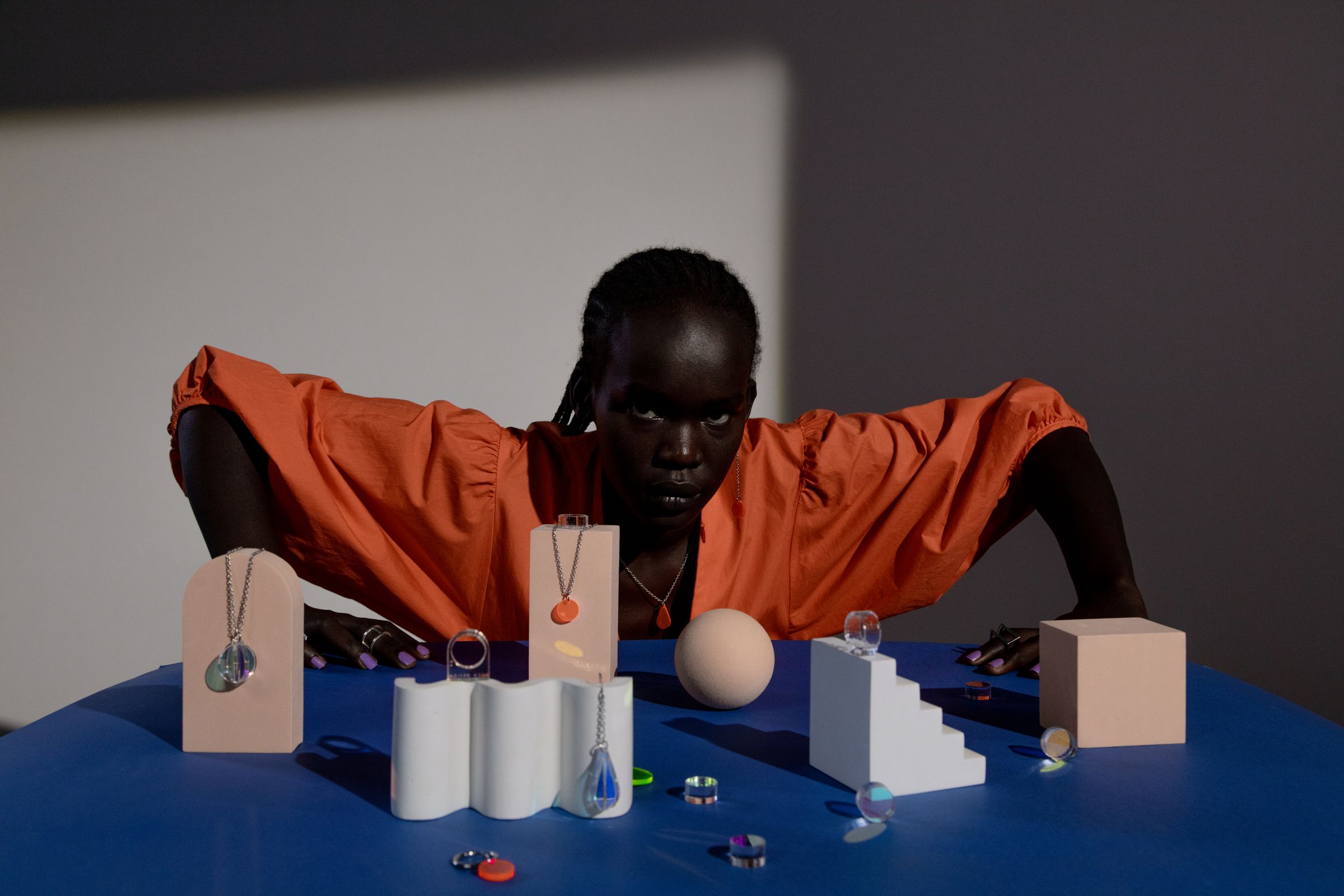
For most of the last century, a woman shopping for sparkle had two doors to choose from. Behind one stood the diamond — precious, permanent, priced accordingly. The stone of proposals and milestones, bought rarely and kept for life. Behind the other stood crystal, most famously Swarovski’s: brilliant, affordable, everywhere. The sparkle you bought for a season and didn’t overthink. Between the two lay a wide, oddly empty space — real gemstone beauty without the mined-diamond price, made to last rather than to last a summer. That space is where Zeverra has quietly set up shop, and it is turning out to be a more interesting place than anyone expected.
To understand why Zeverra is not simply “a cheaper diamond” or “a fancier crystal,” you have to look at what actually makes a stone catch the eye — and here the newcomer does something the old two-door choice never allowed.
The science of the sparkle
Sparkle, stripped of romance, is two separate things. There is brilliance — the white light a stone throws back at you — and there is fire, those little flashes of spectral colour that flicker as a hand moves. Diamonds are famous for both, and rightly so. But Zeverra, a gemstone engineered in a laboratory from silicon carbide, out-performs the diamond on the more theatrical of the two.
Its fire — governed by a property gemmologists call dispersion, essentially how emphatically a stone splits light into rainbow — is more than double a diamond’s. In plain terms, a Zeverra stone flashes more colour, more often, and more vividly than the mined stone it is so often compared to. Its brilliance runs high too, high enough that a well-cut Zeverra reads as luminous even in the low light of a restaurant or a winter afternoon. It is, by the numbers, one of the most fiery colourless stones you can wear.
This is where the comparison to crystal quietly falls apart. Swarovski and its peers make a beautiful product, precisely cut and genuinely lovely — but it is crystal, which is to say a form of glass. Glass can be cut to sparkle, but it cannot rival the optical performance of a true hard gemstone, and it was never meant to. Zeverra is not glass. It is a real, grown gemstone, and it behaves like one.
The part crystal can’t promise
Which brings us to the difference that matters most once the piece is actually being worn: it lasts.
Crystal has a short, glamorous life. Worn often, it scratches, dulls, and clouds — the sparkle you fell for gradually goes flat, which is precisely why crystal jewellery is bought in the spirit of fashion rather than permanence. A diamond, of course, is nearly indestructible, but you pay for that permanence up front and handsomely.
Zeverra sits, again, in its own place. It is one of the hardest materials used in jewellery — close to a diamond, and far, far above crystal — which means it keeps its crisp facets and its brilliance through the knocks of daily life. It does not cloud. It does not go soft. A Zeverra stone bought today will throw the same fire in a decade.
And the brands building around the stone are confident enough to put that in writing. Luce di Monti, the house bringing Zeverra to market as finished jewellery, backs the stone with a lifetime guarantee — a promise no crystal maker could credibly offer and one that quietly reframes what “affordable sparkle” is allowed to mean. Affordable, it turns out, no longer has to mean disposable.
The number that changes the conversation
Then there is the price, which is the part that tends to make people look twice.
A diamond of any real presence runs into the thousands, often many thousands. That is the cost of the category, and for the couples and occasions that want a mined diamond, it is money well spent. But it also means that, for most of a woman’s life and most of the moments she wants to mark, the diamond simply isn’t in the conversation. Crystal filled that gap for decades on price alone — beautiful, cheap, temporary.
Zeverra collapses the trade-off. At Luce di Monti, a piece set with a Zeverra stone — cut to that signature fire, backed for life, made in the house’s restrained, quietly luxurious style in 18K gold vermeil — starts at around €350 for a wedding band. That is a fraction of a comparable diamond piece, and a world away from it in permanence and quality from anything in the crystal aisle. It is, in other words, the sparkle and the substance of something far more expensive, at a price that lets a woman buy it for herself on a Tuesday.
A stone for how women actually buy now
None of this would matter if it didn’t meet the moment, but it does — almost suspiciously well.
The way women buy jewellery has changed. The dominant story is no longer a man choosing a stone for a woman; increasingly it is a woman choosing for herself, to mark her own milestones, on her own schedule, with her own money and her own taste. That buyer is design-led and quietly sceptical. She researches. She is unmoved by the old mystique of scarcity, and she is entirely comfortable with the idea that the most beautiful, most brilliant option might also be the most modern one — made in a lab, traceable, and unbothered by a mine.
For her, Zeverra reads not as a compromise but as an upgrade: more fire than the traditional stone, a hardness that survives a real life, a guarantee that removes the risk, and a price that removes the guilt. And Luce di Monti gives it a wardrobe — pieces designed with restraint rather than spectacle, the sort of jewellery that looks expensive precisely because it isn’t shouting.
It helps, too, that the whole proposition is quietly honest. There is no pretence that Zeverra is a diamond, and no need for one. It is its own thing — which is exactly why the diamond-versus-crystal framing that has shaped jewellery counters for generations doesn’t quite fit it. Zeverra isn’t trying to win either of those arguments. It has simply opened a third door.
The third door
What Zeverra has really done is expose how false the old choice always was. Precious-but-unaffordable on one side, affordable-but-disposable on the other, and nothing in between — that was never a law of nature, only a limit of what the materials could do. Engineer a stone that out-sparkles the diamond, wears like a gemstone rather than glass, comes with a lifetime guarantee, and costs a fraction of the traditional option, and the two-door choice starts to look quaint.
The diamond will always have its place, and crystal will always have its season. But for the growing number of women who want genuine, lasting brilliance without the ceremony or the price tag, there is now a stone that answers to neither — and a house in Luce di Monti giving it a form worth wearing. Call it the third way to sparkle. It may turn out to be the one that suited us best all along.