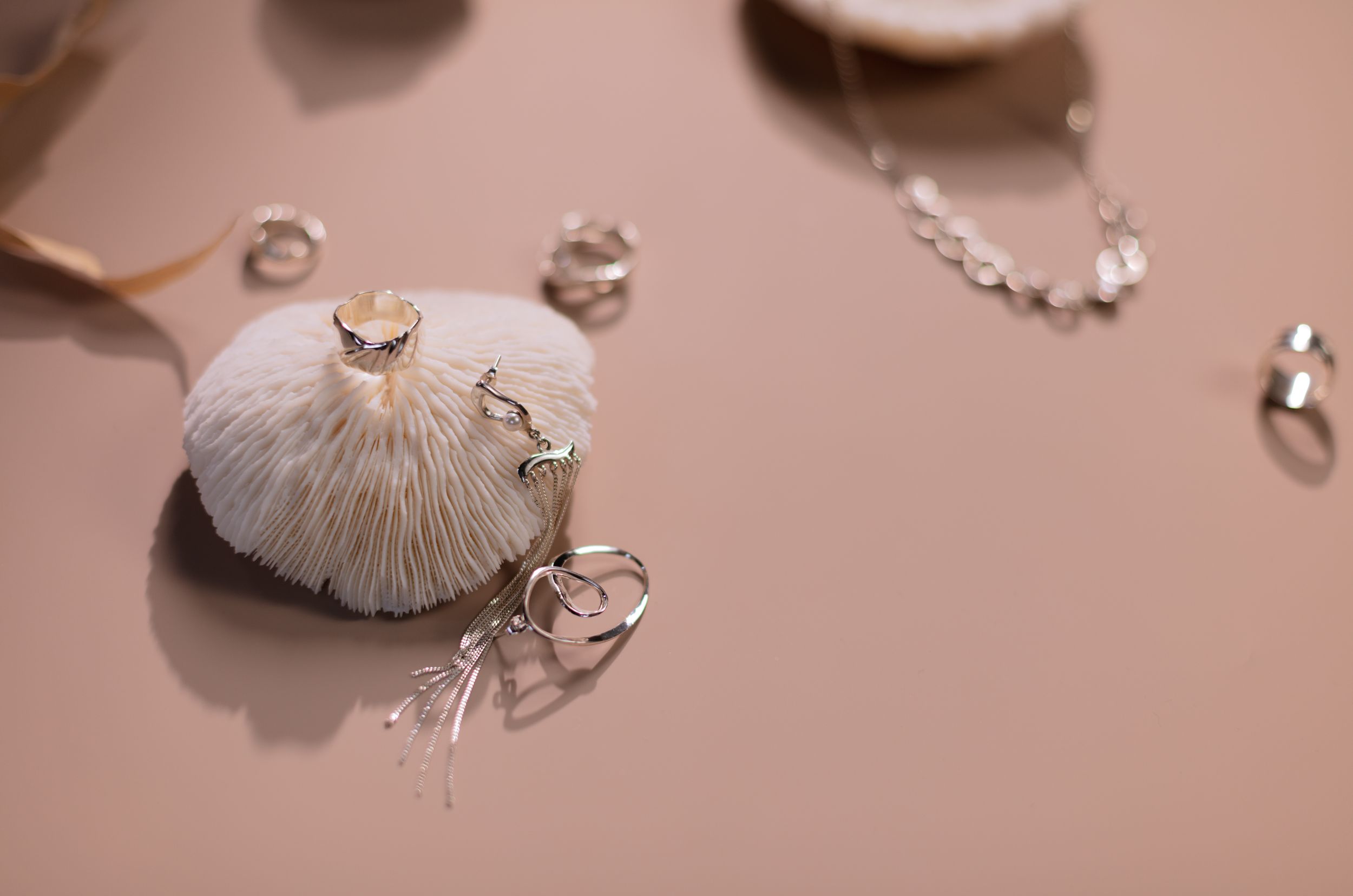
Fashion moves at the speed of a season. Jewellery moves at the speed of a lifetime. It is one of the only things a person wears that is expected to outlast them, to be handed on, to accumulate meaning rather than shed it, and that single fact changes everything about how it is designed and made. A garment is finished when it is worn. A piece of jewellery is barely started.
Bespoke jewellery sits at the intersection of art, engineering and biography, and the process behind it is far more interesting than the finished photographs suggest. This is a look inside how a piece actually comes into being, from a conversation to an object, and why the craft continues to matter in an age that can print almost anything.
It begins with a conversation, not a drawing
The first stage of bespoke work is closer to an interview than a design brief. A good jeweller wants to know who will wear the piece, what they already wear, what they do with their hands, what they are drawn to and what they quietly dislike. Reference images help, but so does knowing that the wearer is a potter, or never takes anything off, or has always loved their grandmother’s rings, or hates anything that catches on a sleeve.
This is where bespoke separates from customisation. Choosing a metal and a stone from a menu is configuration. Designing from a conversation is authorship, and it produces objects that could not have been arrived at any other way. The best pieces tend to come from clients who describe a person rather than a product, and from makers who listen for what is not being said.
Drawing, and the moment the computer takes over
Most designers still begin with a pencil, because a sketch is fast, disposable and honest, and because thinking happens more freely by hand. From there, contemporary practice moves to computer-aided design, where the piece is built as a precise three-dimensional model. The render that comes out of it is a strange and useful object: photorealistic enough to make decisions from, and infinitely cheaper to change than metal.
This is the stage where a client should be at their most demanding, because every alteration is free on screen and expensive afterwards. Band width, the height of a setting, the curve of a shoulder, the exact angle at which a stone sits, all of it is negotiable here and effectively fixed later. Good studios treat the render as a conversation rather than an approval form, and the pieces that disappoint are almost always the ones where this stage was rushed.
From wax to metal: a process older than most industries
What happens next is essentially unchanged since antiquity, which is remarkable given the software that preceded it. The digital model is grown as a wax or resin pattern, usually by a specialised three-dimensional printer. That wax is encased in investment plaster, and the whole thing is fired in a kiln until the wax burns away entirely, leaving a perfect void where the piece used to be. Molten metal is then poured or spun into that cavity.
This is lost-wax casting, and it is thousands of years old. Bronze age craftsmen used it. Renaissance goldsmiths used it. The only thing that has changed is how the wax gets made. There is something genuinely moving about a process where the original must be destroyed for the object to exist, and where the newest technology in the studio feeds directly into the oldest one. Contemporary jewellery is a conversation between a printer and a kiln.
Handmade cannot be automated
What comes out of a cast is not jewellery. It is a rough, grey, unremarkable lump with a sprue attached, and everything that makes it beautiful happens afterwards, by hand. The sprue is cut, the surface filed and sanded through progressively finer grades, the form refined, and then the stones are set, one at a time, by a person bending metal a fraction of a millimetre at a time to hold something irreplaceable. Setting is the highest-stakes moment in the entire process: a slip cracks a stone, and there is no undo. This is where bespoke jewellery design reveals itself as craft rather than manufacture, and why studios such as Stelios Jewellers in Perth, handcrafting pieces since 2007, still turn on the skill of individual hands at a bench.
Then comes polishing, which is where an object becomes alive. The difference between a competently finished piece and a beautifully finished one is invisible in a description and unmistakable in the hand. Light behaves differently. Edges read crisper. The piece acquires the quality that photographs never quite capture and that people recognise instantly without being able to name. None of this can be automated, which is precisely why it remains valuable.
Designing for a body, not a plinth
Jewellery has a constraint that other design disciplines rarely face: it must work on a moving, warm, three-dimensional human being who will wear it while doing the washing up. A ring has to pass a knuckle and then sit still. A pendant has to hang correctly rather than twist. Earrings have to be light enough to wear for six hours. A bracelet has to survive a desk.
This is why so much conceptual jewellery fails the moment it leaves the exhibition. An object that photographs beautifully and cannot be worn is a sculpture, which is a legitimate thing to be but a different thing entirely. The discipline of bespoke design is holding an aesthetic idea and a set of brutal physical constraints in mind simultaneously, and refusing to sacrifice either. The pieces that succeed are the ones where the constraint made the design better rather than smaller.
Ethics, materials and the questions worth asking
The material conversation has changed sharply, and for the better. Recycled precious metals are now standard practice in serious studios rather than a marketing line, since gold and platinum are infinitely recyclable without any loss of quality. Lab-grown diamonds have given designers a stone with an entirely different cost and ethical profile, opening scale and ambition that would previously have been unaffordable. Provenance questions around mined stones are asked far more often, and the Kimberley Process, however imperfect, at least established the expectation that origin should be traceable.
There is also a growing interest in stones with a specific story rather than a specific grade: Australian sapphires from Queensland and New South Wales, South Sea pearls from Broome, coloured stones with a known source. For a generation sceptical of anonymous luxury, knowing where a material came from and whose hands worked it is increasingly the point rather than a footnote.
The second life of an object
The most quietly radical thing about jewellery is that it can be unmade and remade. An inherited ring that nobody wears, in a style that suits no living person, can have its stones lifted and reset into something that will be worn every day. The material persists; the form changes. Nothing else in a wardrobe works this way. A dress from 1950 is a dress from 1950 forever.
This is where jewellery’s relationship with time becomes genuinely unusual. A single stone might pass through three settings and four generations, carrying the accumulated weight of every hand it sat on. The designer’s job, in those cases, is not self-expression but stewardship: to build a new object that respects what came before without embalming it. It is one of the few design problems where the brief includes people who are no longer alive.
The apprenticeship problem
There is a quiet crisis behind the craft. Bench skills, stone setting in particular, take years to acquire and cannot be learned from a screen. A setter needs thousands of hours before their hands are reliable enough to be trusted with a client’s diamond, and that training only happens by sitting beside someone who already knows. As manufacturing has migrated offshore and retail has consolidated, the number of benches where that apprenticeship can happen has shrunk in most Western countries.
This is why small independent studios matter beyond their output. They are the places where the transmission still occurs, one person to another, in the only way it can. Every studio that keeps a bench and takes on someone junior is holding open a line of knowledge that is genuinely difficult to restart once broken. When people talk about supporting craft, this is the concrete version of it: not nostalgia, but the continuity of a skill that has no shortcut.
What the camera cannot show
Jewellery has an awkward relationship with photography, which is a problem for a discipline now largely discovered through screens. A diamond’s behaviour is dynamic: it fires colour as it moves, catches light differently as a hand turns, and does things in a room that a still image simply cannot record. Photographs flatten all of it, which is why two stones that look identical online can be dramatically different in the hand, and why lighting in a photograph can make a mediocre stone look superb.
The same is true of finish and weight. The heft of a well-made ring, the way a polished edge catches, the difference between a competent and an exquisite surface, are tactile facts that no render captures. This is the genuine limitation of buying jewellery online, and the reason serious makers still insist on putting stones and pieces in front of people. The object exists in three dimensions, in motion, on a body. Everything else is a description of it.
Where the discipline is heading
The near future of jewellery is unusually interesting because two opposite forces are pulling at once. Technology keeps expanding what is possible: printing, digital modelling and lab-grown stones have removed constraints of cost, geometry and scale that shaped the discipline for centuries, and designers are producing forms that could not previously have been made or afforded. At the same time, there is a sharpening appetite for the handmade, the traceable and the singular, precisely because everything else has become so easy to produce.
The likely resolution is not one winning but both being used honestly: technology for what it does well, precision, iteration and access, and the hand for what it alone does, the judgement, the finish, the setting and the authorship. The studios that thrive will be the ones fluent in both and candid about which is which. What will not change is the underlying proposition, which has survived every technological shift so far: someone made this, deliberately, for someone, and it will outlast them both.
The atelier parallel
Anyone who follows fashion already understands bespoke jewellery, they simply have not been told the vocabulary transfers. Haute couture, a term legally protected in France by the Chambre Syndicale de la Haute Couture, describes garments made to measure by hand for a single client, and the petites mains who execute them spend hundreds of hours on beading, embroidery and finishing that a camera can barely register. Swap the beadwork for stone setting and the sketch for a CAD model and you have described a jewellery studio exactly.
The difference is what happens after the shoot. A couture gown is an event, worn once, archived, immortal as an image. A ring is worn to the supermarket for forty years, resized twice, repaired, and handed on. Jewellery is the only branch of the applied arts where the client’s grandchild is a stakeholder in the design brief, and that changes the calculus of every decision a maker makes. Fashion designs for the season and occasionally for the archive. Jewellery designs for probate.
Australian materials with a colour story
Contemporary Australian studios have access to a materials palette that most of the world does not, and it is more interesting than the diamond monoculture suggests. Australia produces the overwhelming majority of the world’s opal: black opal from Lightning Ridge in New South Wales, with its dark body tone making the colour play read like something lit from inside, and the lighter material from Coober Pedy in South Australia. Sapphires come from the fields around Anakie and Rubyvale in Queensland and Inverell and Glen Innes in New South Wales, in teals and greens and yellows that the Ceylon-blue orthodoxy overlooks entirely.
Then there are the two Australian materials that carry genuine mythology: the Argyle pink diamonds from the Kimberley mine that closed in 2020, now a permanently finite supply, and the South Sea pearls grown in Pinctada maxima off Broome, the largest pearl oyster on earth. Each of these demands something different from a designer. Opal in particular is a discipline, sitting around 5.5 to 6.5 on the Mohs scale and holding water in its structure, which means it can craze and cannot be set or worn like a sapphire. Designing around a material’s fragility rather than ignoring it is where a maker’s real judgement shows.
At the bench
The physical reality of the work is less romantic and more impressive than the photographs imply. A jeweller sits at a bench peg, a small wooden wedge that has not changed in centuries, cutting with a saw whose blade is finer than a hair and snaps if you breathe wrong. Setting is done with gravers and a loupe, most commonly a ten-times magnification, and the setter is pushing metal a fraction of a millimetre at a time to close a claw over something irreplaceable. Pavé, channel, bezel and milgrain each demand a different hand, and a millimetre of misjudgement is visible forever.
Craftspeople at studios such as Stelios Jewellers, a workshop in Mt Hawthorn, Perth, founded by jeweller Stelios Palioudakis in 2007, describe the two emotional poles of the job with some candour. One is the low, specific dread of setting a client’s inherited stone, the only one in existence, knowing a slip cannot be undone. The other is the moment that stone goes back onto a hand, reset and alive again after thirty years in a drawer, and the owner does not say anything at all because they cannot. That second thing is what keeps people at a bench for a career, and it is not a feeling that the finished product photograph has ever managed to carry.
Why the craft survives
Anything can be mass-produced now, cheaply and well, which by the usual logic should have finished bespoke jewellery decades ago. It did not, and the reason is worth noticing. The value of these objects was never really in the materials, which are commodities, or in the novelty, which fades. It is in the fact that a specific person thought about a specific other person and then made something that did not exist before, by hand, that will outlast them both.
In a culture that produces enormous volumes of disposable everything, an object designed to be repaired, resized, reset and handed on is a quiet argument. Bespoke jewellery is slow, difficult, and dependent on skills that take a decade to learn and cannot be shortcut. That is not an inefficiency in the model. That, precisely, is the product.